





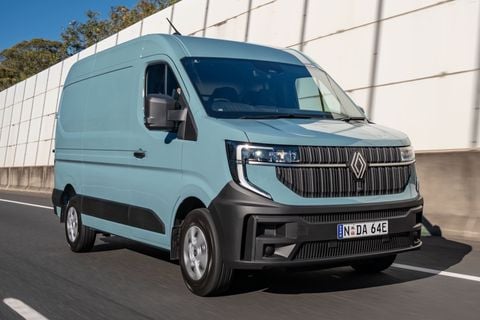
2026 Renault Master review: Quick drive
For commercial buyers needing space and security, big vans are the answer. But is the all-new Renault Master now the segment leader?

CarExpert's verdict on the Master
Very Good
What we love
- Quality interior
- Neutral handling, good roadholding
- New auto is a big improvement
Worth a thought
- Delay off the line
- Ergonomics aren’t perfect
- Missing some basic technology
Are there other rating labels?
- Excellent
- An outstanding car in almost every way. A joy to drive, packed with great features, and highly recommended.
- Very Good
- A well-rounded car that's enjoyable to drive, offers great value or features, and is easy to recommend.
- Good
- A solid choice that does most things well. Comfortable, capable, and worth considering in this segment.
- Average
- Meets the standard for this segment. May not stand out, but still a dependable and reasonable option.
- Below Average
- Falls a bit behind others in the segment, but still passes safety checks and may suit specific needs or budgets.
Introduction
The 2026 Renault Master is the first all-new generation of the large commercial van in 15 years, with some significant advances being offered – including, for the first time in Australia, electric powertrains.
Renault actually unveiled the new fourth-generation Master back in late 2023, but it’s taken until now for the model to reach Australian shores, and the French brand says it leapfrogs the competition thanks to new powertrains and technology.
That includes the battery-powered Master E-Tech, which uses a single electric motor on the front axle, offering more than 400km of claimed driving range. For most buyers though, it’s expected the diesel-powered models will still be the van of choice.
In a pleasant surprise, Renault has retained a six-speed manual transmission for the base grade, with the rest of the lineup getting a new nine-speed torque-converter automatic – another pleasant surprise.
It’s arguably one of the nicer-looking large vans on the market, with the front-end design said to echo Renault’s prime mover trucks in Europe, adopting attractive C-shaped daytime-running lights.
The company says it’s been listening to its customers, introducing smart features like footsteps in the front bumper to make it easier to check fluids and undertake maintenance, and magnetised stops for the rear barn doors so there’s less chance of them slamming shut in a breeze.
The diesel vans have payloads of between 1811kg and 1923kg, whereas the electric alternatives see reduced payloads of 1084kg to 1164kg – with braked towing capacities of up to 2000kg across the range.
In Australia, the Master range comprises medium-wheelbase (MWB) and long-wheelbase (LWB) bodies, with MWB vehicles measuring 5685mm long, 2080mm wide and, for the standard roof, 2498mm tall – riding on a 3585mm wheelbase. LWB vehicles are 6315mm long with a wheelbase of 4215mm.
Opt for the high roof, and body height increases to 2778mm.
The obligatory sliding passenger-side door is standard (a driver's-side door is optional), and larger than that of the last Master's, while the rear barn doors have the ability to open to 270 degrees to allow a Euro pallet to be loaded and unloaded with a forklift. A new door stop also means the barn door won’t clash with the sliding door when they are both fully open.
The electric Master E-Tech variants aren’t due in Australia until the first quarter of 2027, but CarExpert was invited to the local launch of the Renault Master to sample some diesel-powered vans.
How much does the Renault Master cost?
The Renault Master starts from $55,990 before on-road costs for the mid-wheelbase model with a manual transmission, or $59,990 plus on-roads for the automatic.
| Model | Price before on-road costs |
|---|---|
| Master MWB standard roof manual | $55,990 |
| Master MWB standard roof auto | $59,990 |
| Master LWB standard roof auto | $61,990 |
| Master LWB high roof auto | $65,990 |
| Master E-Tech MWB standard roof | $77,990 |
| Master E-Tech LWB standard roof | $79,990 |
For diesel variants, the Master tops out at $65,990 plus ORCs, while the Master E-Tech will cost between $77,990 and $79,990 plus ORCs when it arrives in early 2027.
Apart from being the newest kid on the block, that makes the Renault arguably one of the best-value large vans on the market, being quite a bit cheaper than the equivalent Sprinter from Mercedes-Benz.
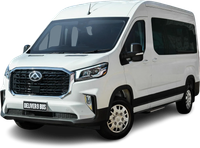
Only the LDV Deliver 9 is cheaper, starting at $51,568 plus ORCs, while the Volkswagen Crafter is available from $59,990 drive-away.
Compare the Renault Master
Want to see how the Renault Master lines up against the competition?
Use our comparison tool for a side-by-side look at the specs, features and prices of the Master and its rivals.

What is the Renault Master like on the inside?
The all-new Renault Master brings a clean-sheet approach to designing the interior.
While it looks fresh and modern, it’s good to see Renault’s people didn’t go nuts and try to turn the van into a spaceship. There are clean lines, practical additions, and plenty of buttons and knobs inside.
The 10-inch infotainment touchscreen runs the OpenR Link operating system, which is fast and attractive, and pretty easy to navigate for the most part. Audio quality is good enough, without being outstanding.
The wireless Apple CarPlay worked well during our time with it, and while they make balancing a hand on the top of the screen slightly more difficult, we appreciated having physical volume buttons along the top of the screen’s shell.
It’s a little surprising that the system doesn’t include DAB+, with digital radio being a standard feature on most new models for a long time – and also given tradies love listening to Triple M Country while smashing a sausage roll and a Farmer’s Union iced coffee.
Diesel-powered Masters also miss out on Renault’s connected services, though I suspect this will be less of an issue for most buyers.
Despite the lack of digital radio and connected services, it doesn’t come across as a bare-bones interior, as can be the case with some light commercial vans. The upholstery of the seats looks high-quality and classy, but still feels like it will last a decent amount of time.
It’s a similar deal with the plastics, which are hard and hardy, but don't actually feel cheap, hollow, or overly scratchy. This is partly due to the excellent build quality, making the Master feel solid and dependable, and like it was made to last.
The switchgear is also fantastic. Climate control is included in the optional Business Pack; it comes with three dials that are easy and satisfying to use, and each comprises attractive black and white digital displays.
We appreciated the leather-wrapped steering wheel, which does a good job of subconsciously tricking your brain into thinking you’re driving something other than a commercial vehicle.
While I dislike column-mounted shifters – specifically the ones that replace (yet continue to look like) indicator stalks – the drive selector in the Master sits higher than the wiper stalk and feels different to touch. As a result, it works better than many others.
Rather than stereo buttons on the steering wheel, Renault continues to go with a more old-school approach, fitting a remote control nubbin behind the steering wheel at the four o’clock position. It works well, but it also means there are essentially four different stalks – one on the left for the indicator, and three on the right for the drive selector, indicator and lights, plus the stereo. Not necessarily a bad thing, but you might have to take a split second to decide which lever to pull.
Renault people were keen to point out the outboard cupholders, which have been designed to double as grab handles to help you climb in and out of the cabin. Though I appreciated the attempt, the fact is if you have a coffee in your cupholder, you can’t easily use it as a grab handle. And because it’s so low, it’s more difficult to use to lower yourself down and out of the van from the driver's seat. I also found myself instinctively reaching for the dedicated grab handle on the A-pillar that doesn’t exist.
Behind the seats is a steel cargo barrier, helping to reduce the noise from the back of the van. It comes with a window for the traditional rear-view mirror. You can option a digital rear-view mirror, which deletes the window, and allows you to see out the back of the van when the vehicle is fully loaded – though there is a reversing camera as standard.
There’s an okay amount of adjustability for the seat and steering wheel, but I had a hard time getting into a comfortable driving position, and wasn’t able to find how to adjust lumbar support on the fly.
I’m not known for having anything resembling good posture, but everything felt a little too upright and straight-ahead, in terms of driver ergonomics. This was partly due to the giant central dash console, which houses only the inboard cupholder and restricts the driver's left knee.
I did find that the unnecessarily large cupholder seemed to be perfectly designed to hold my iPhone in the vertical position, but I would have happily given up that functionality to be able to relax my left leg.
Cupholders aside, Renault has done a stellar job with storage. The vans we sampled had the Business Pack optioned, which – like the Trade Pack – has a sort of desk built into the back of the middle seat, allowing you to access and use a laptop when it’s folded down. There are also endless cubbies and hidey-holes in the doors and dash.
Out back, it's pretty standard fare for a large van. There are a handful of tie-downs for large or heavy cargo, and some strong steel grab handles to hoist yourself in and out. Renault says the aperture of the side door has increased to help with loading, and the floor height is reasonably low.
| Dimensions | Renault Master MWB | Renault Master LWB |
|---|---|---|
| Length | 5685mm | 6315mm |
| Width | 2080mm | 2080mm |
| Height | 2498mm | 2498mm (standard roof) 2778mm (high roof) |
| Wheelbase | 3585mm | 4215mm |
| Cargo volume | 10.8m³ | 13.0m³ (standard roof) 14.8m³ (high roof) |
To see how the Renault Master lines up against the competition, check out our comparison tool
What's under the bonnet?
The Renault Master will be available with three powertrain configurations: a diesel with manual or automatic transmissions, or an electric powertrain arriving in 2027.
| Specifications | Renault Master |
|---|---|
| Engine | 2.0-litre turbo-diesel 4cyl |
| Power | 125kW @ 3500rpm |
| Torque | 380Nm @ 1500rpm |
| Transmission | 9-speed torque-converter automatic |
| Drive type | Front-wheel drive |
| Weight | 2027-2189kg |
| Fuel economy (claimed) | N/A |
| Fuel economy (as tested) | 7.8L/100km |
| Fuel tank capacity | 80L |
| AdBlue tank capacity | 20L |
| Fuel requirement | Diesel |
| Emissions standard | Euro 6 |
| Braked tow capacity | 2000kg |
For the Master E-Tech, the electric motor puts out 105kW of power and 300Nm of torque, and is supplied by an 87kWh battery delivering 409km of driving range on the WLTP test.
Meanwhile, the 2.0-litre turbo-diesel four-cylinder engine sends 125kW and 380Nm to the front wheels, and is certified to the Euro 6 emissions standard.
Being a 4000kg (GVM) commercial vehicle, Renault isn’t required to supply fuel economy ratings for the diesel variants. However, our short time with the van resulted in average consumption of 7.8L/100km with a 750kg load in the cargo area. For context, that was roughly the same fuel consumption we experienced in a Mazda CX-3 recently.
To see how the Renault Master lines up against the competition, check out our comparison tool
How does the Renault Master drive?
Out on the road, it’s immediately clear there’s been a lot of thought put into making the Renault Master more comfortable, stable, and approachable for the driver.
In the past, large commercial vans could feel a little intimidating – like you were piloting a tin box with skinny wheels off a soapbox.
The Master doesn’t come across like that. It’s smoother from the outset, and tilts slightly towards the character of an SUV than a big bus.
The 2.0-litre turbo-diesel has a good amount of torque off the line and in the mid-range, getting the Renault up to speed without much fanfare, and is helped by the nine-speed auto.
The introduction of the conventional torque-converter automatic is very welcome, replacing the antiquated single-clutch automated manual transmission of the previous generation that was an absolute slug.
While the nine-speed auto doesn’t quite match the silky smoothness of a ZF eight-speed – typically the industry benchmark, and as such is used across a host of vehicles – the Master’s new transmission is a massive improvement over the old AMT, and ensures the van is accessing the right cog for whatever is being asked of it.
Perhaps one of its biggest advantages over the outgoing model is at low speeds. Navigating car parks, reversing into tight spaces, conducting three-point turns – the smoothness of the traditional automatic means there’s no second-guessing the robotic clutch, like in the last one.
As an aside, the Renault has a turning circle of 12.8 metres for the mid-wheelbase and 14.9m for the long-wheelbase – which are some of the better figures in this segment, but it falls short of the Mercedes-Benz Sprinter's turning circle of 12.3m for MWB and 14.3m for the LWB. Regardless, the kerb-to-kerb turning circle of the new Master is a giant improvement over the one it replaces, so posties should be happy.
While it's smooth and strong, the Master isn’t about to win any drag races. It’s a little too slow when waking up from the engine idle-stop function at traffic lights, and pressing the throttle to the firewall doesn’t add that much more power to the mix.
Drive it aggressively, and you may find yourself getting frustrated.
But take it down a couple of notches, using that mid-range torque and allowing the vehicle to roll through its nine ratios, and it’ll do a pretty good job of keeping ahead of traffic. Slow is smooth, smooth is fast.
Surprisingly, adding 750kg of weight to the cargo area didn’t seem to faze the powertrain much at all, even on steeper inclines.
It’s a similar story with the ride. It soaks up bumps better than a lot of one-tonne utes out there, but has a payload capacity of almost double that. With or without a load in the back, it didn’t become busy or scary when encountering pockmarked roads.
The barrier behind the seats ensures the Master doesn’t suffer from the same deafening din that resonates through the cargo area like a steel guitar – as is the case with most vans when driving at speed.
However, there is quite a bit of noise from the wheels over rough roads. It’s not actually uncomfortable, but is almost like an audio illusion, tricking your brain into thinking the experience is more assaulting than it actually is.
Handling and roadholding are particularly impressive. Vans can feel both top-heavy and front-heavy, not helped by skinny light-commercial tyres and cheap suspension. The new Master isn’t like that at all, with a confident, planted feeling on the road, and displaying some composure through corners – assisted by Continental rubber at each corner.
Our time with the Master was limited, but we were able to test the van on industrial roads, in suburban traffic, on the freeway, and along sweeping country roads in the wet. Nothing seemed to faze the big girl, with the vehicle easy to place in the lane and navigate around small roundabouts and angled T-intersections – assisted by decent outward visibility.
Jumping into the driver’s seat for the first time, I almost put my passenger’s head through the windscreen when using the brakes for the first time. My experience with big vans is there’s quite a long and spongy throw to the brake pedal, but that isn’t the case here. Renault has highlighted the new braking system in the Master as a big improvement, and it’s true the brakes now feel more akin to those of a passenger car's, with a good level of performance helping add to the confidence of the vehicle.
That same feeling of build quality from the interior is apparent in the chassis. Don’t be fooled, this is still a light commercial vehicle built to work long days and cover bulk distances, year after year, but its on-road character doesn’t feel like Renault has cut any corners under the skin.
The French automaker may not have cheaped out on the hardware, but it did save some pennies on tech. Like the lack of digital radio, the Master misses out on adaptive cruise control in Australia. For those who find themselves in medium to heavy freeway traffic for any decent period, this could well be a dealbreaker.
Thankfully, the advanced driver-assist system – better known as ADAS – worked quite well during our drive. Only once did the lane-keeping tech get annoyed at me for not being perfectly centred, but it wasn't constantly hounding me for minor indiscretions.
To see how the Renault Master lines up against the competition, check out our comparison tool
What do you get?
There's only one grade of the Renault Master available, though buyers can option either the Trade Pack or Business Pack – or both.
2026 Renault Master equipment highlights:
- Three-seat layout
- Steel bulkhead with window
- Passenger-side sliding door
- Rear barn doors
- Automatic headlights
- Rain-sensing wipers
- Analogue instrument cluster with 3.5-inch digital display
- 10.0-inch touchscreen infotainment system
- Google Automotive Services (E-Tech only)
- 2 x USB-C ports
- Steering wheel paddle shifters (diesel only)
- Blind-spot monitoring
- Lane-keep assist
- Rear parking sensors
- Reversing camera
Options
Trade Pack ($800) adds:
- Work office table
- External reverse sound
- LED cargo lighting
- Rear step board
Business Pack ($1000) adds:
- Work office table
- Climate control
- LED cabin lighting
- Keyless entry with walk-away locking
- Push-button start
The Trade and Business packs can also be combined for $1500. Other individual options include:
- Digital rear-view mirror (deletes bulkhead window): $1300
- Front and side parking sensors (deletes blind-spot monitoring): $500
- Two-seat option (standard roof diesel automatic models): $400
- Wooden flooring with mid-height cargo area wall lining (MWB): $900
- Wooden flooring with mid-height cargo area wall lining (LWB): $1000
- Wooden flooring with full-height cargo area wall lining (MWB): $1990
- Wooden flooring with full-height cargo area wall lining (LWB): $2100
- Sliding right door (steel panel): $800
- Left sliding door with window: $300
- Left and right sliding doors with windows: $1300
- Left and right sliding doors with windows, plus rear quarter panel windows: $1600
- Windowless rear barn doors: $NCO
- Steel bulkhead delete (only available with two-seat option): $NCO
- Vehicle alarm: $500
- Brake wear indicator: $150
To see how the Renault Master lines up against the competition, check out our comparison tool
Is the Renault Master safe?
The Renault Master has yet to be classified by ANCAP locally, but has received a five-star 'Platinum' safety rating from its sister organisation, Euro NCAP.
Safety features include:
- Autonomous emergency braking
- Blind-zone warning
- Rear cross-traffic alert
- Lane-keep assist
- Speed-sign recognition
To see how the Renault Master lines up against the competition, check out our comparison tool
How much does the Renault Master cost to run?
The Renault Master is covered by a five-year, unlimited-kilometre warranty, with five years of complimentary roadside assistance.
| Servicing and Warranty | Renault Master |
|---|---|
| Warranty | 5 years, unlimited kilometres |
| Roadside assistance | 5 years complimentary |
| Service intervals | 12 months/30,000km |
| Capped-price servicing | 5 years |
| Average annual service cost | $825 |
| Total capped-price service cost | $4125 |
Renault also offers five years of 'assured service pricing', based on long service intervals of 12 months or 30,000km.
While the LDV Deliver 9 matches the 12-month/30,000km service intervals, the Volkswagen Crafter is 12 months or 20,000km. Only the Mercedes-Benz Sprinter is better, with 12-month/40,000km intervals.
To see how the Renault Master lines up against the competition, check out our comparison tool
CarExpert's Take on the Renault Master
The Renault Master takes the large-van recipe and adds some much-needed updates – bringing the model firmly into 2026, and cementing its place as a leader in the segment from a macro perspective.
There aren’t any standout headlines for the diesel van, but the whole package makes for a very approachable and comfortable experience for those who require a big box on wheels.
The new Renault delivers strong roadholding, neutral handling, and easy manoeuvring, which takes a lot of the intimidation factor out of it.
All of which means it’s a perfect candidate for motorhome conversions, for rental fleets, for businesses that value employee retention, and for those who need to transport motorcycles.
But while it's certainly one of the best options in this segment right now, it does seem to be missing some key features. We’d also love to see tweaks to the cabin – like changing the bulky inboard cupholder and adding some A-pillar grab handles – but there isn’t anything here that would stop us from recommending the Master to buyers.
CarExpert can save you thousands on a new Renault Master. Click here to get a great deal.
Click the images for the full gallery



 Automotive Vehicle Spec Data & 4K images Powered by JATO Dynamics Ltd