




William Stopford
2027 Mazda MX-5 update brings more safety tech, higher prices
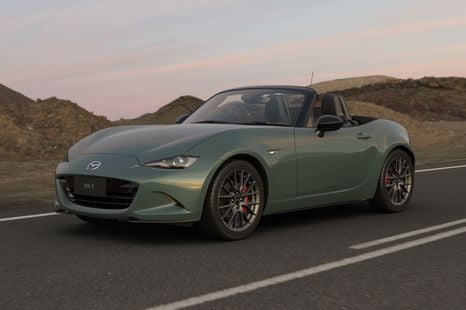
The Mazda MX-5 is now between $1950 and $4950 more expensive, but it has received more standard equipment.
16 Hours Ago
Subaru still has you covered if you fancy a small rear-drive coupe, and it's as good as it has ever been.

Journalist
Journalist
Journalist
Journalist
If this is the car for you, we’ll compare offers from trusted dealers, handle the back and forth and manage your purchase from enquiry to delivery.
Believe it or not, lightweight rear-wheel drive performance cars still exist in the modern day.
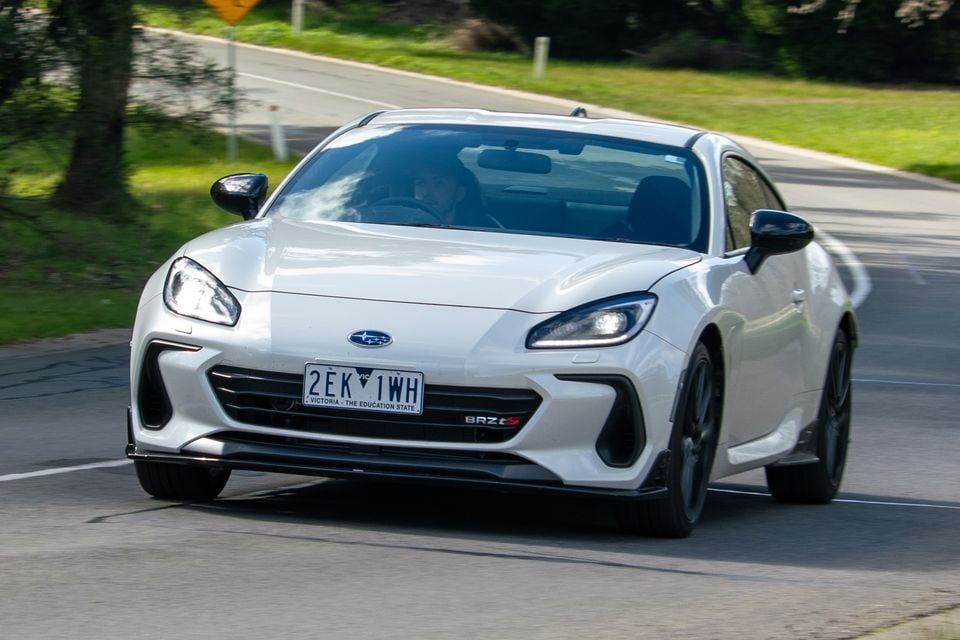
The Subaru BRZ has forged quite a fanbase in the 15-odd years it's been around, especially since the current second-generation model went on sale in 2022. Aside from some running updates, that's still the same car on sale nearly five years later.
As ever, the BRZ is a product of the close working relationship between Subaru and Toyota, the latter of which sells the compact Japanese sports coupe as the GR86. Interestingly enough, it remains the only performance car collaboration between the two, with their more recent co-operations focused heavily on electric SUVs.
However, there have been reports that Toyota could ditch Subaru for the next iteration of its entry-level sports car in favour of a partnership with Mazda, potentially twinning the next GR86 with the next MX-5. None of the three brands has confirmed anything at the time of publication, but it does raise questions about the BRZ's future.
For now, though, we're glad the BRZ exists. It seems buyers are too, because in the first six months of 2026, Subaru shifted 339 examples of its only coupe – 11 more than the more affordable Toyota.
The Mazda MX-5 is still the small sports car sales king with 428 registered in the same period, though it's a less powerful convertible.
As for the BRZ, the current model's running updates in Australia included the addition of the STI-tuned tS trim in 2024 – still available as the 2027 Subaru BRZ tS manual you see on test here. The tS gained a full-size spare wheel in 2025, price parity for automatics and manuals arrived for 2026, and the limited-edition Kiiro was recently available with a special yellow finish.
Prices have continued to rise, though, with the entry-level grade up by $8900 since launch. The tS manual is up by $4100, and that's before the inevitable local arrival of another update revealed in Japan in August 2026.
With all that in mind, how is the second-generation BRZ getting on?
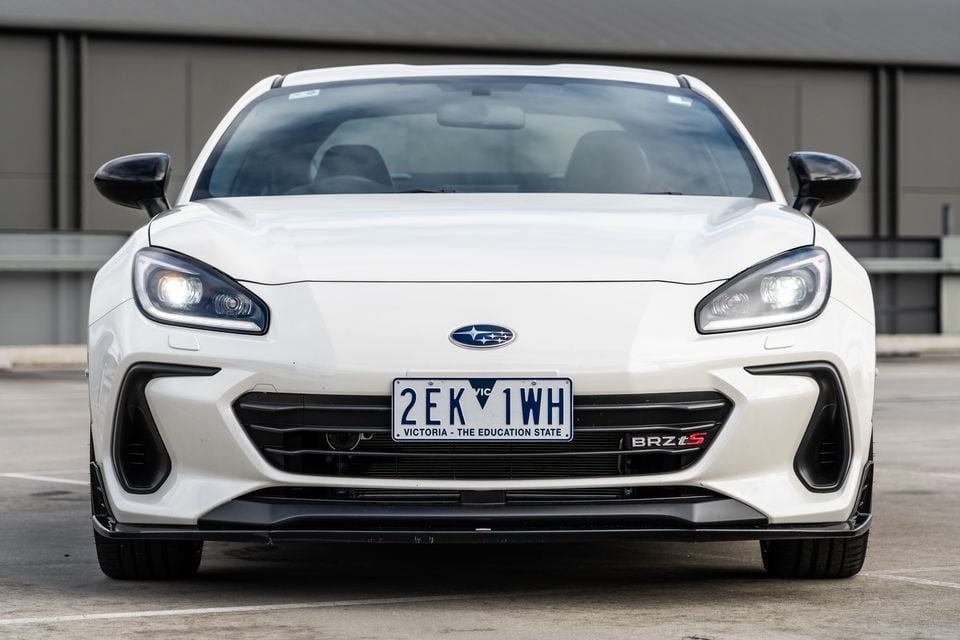
The tS is the flagship Subaru BRZ grade, and it's priced at $52,790 before on-road costs. Buyers can opt for manual or automatic transmissions at no extra cost across the range.
| Model | Price before on-road costs |
|---|---|
| 2027 Subaru BRZ | $47,890 |
| 2027 Subaru BRZ S | $49,190 |
| 2027 Subaru BRZ tS | $52,790 |
It's more expensive than the range-topping Toyota GR86 GTS, which costs $46,090 plus ORCs, but cheaper than the flagship Mazda MX-5 RF GT RS at $56,790 plus ORCs. All three are more affordable than the touring-oriented yet quick-selling Honda Prelude, which costs $65,000 drive-away.
If you're after more performance, the next-cheapest two-door option is the noticeably larger and significantly more powerful Ford Mustang EcoBoost. It starts at $72,990 before on-road costs.
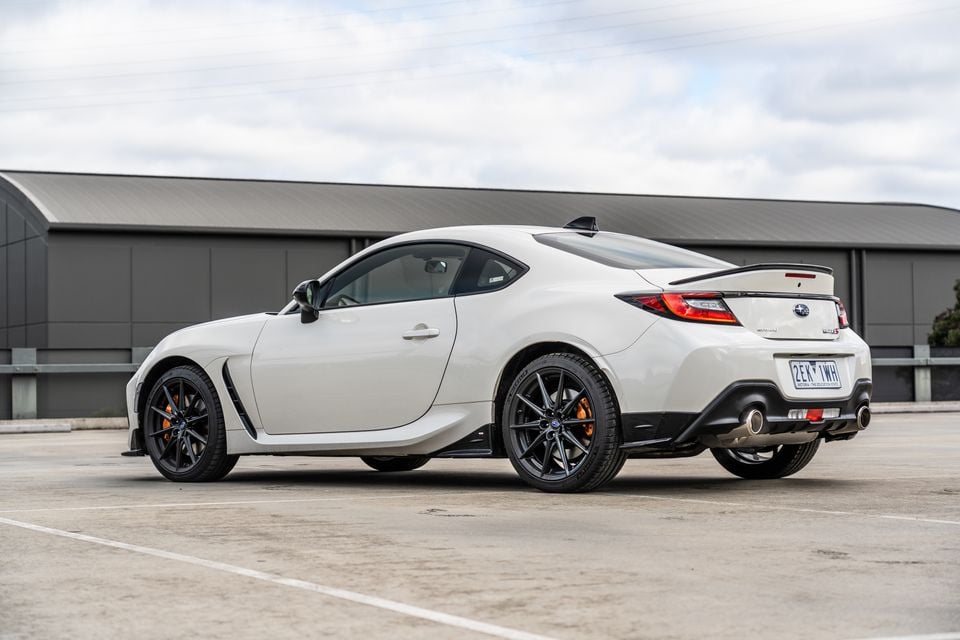
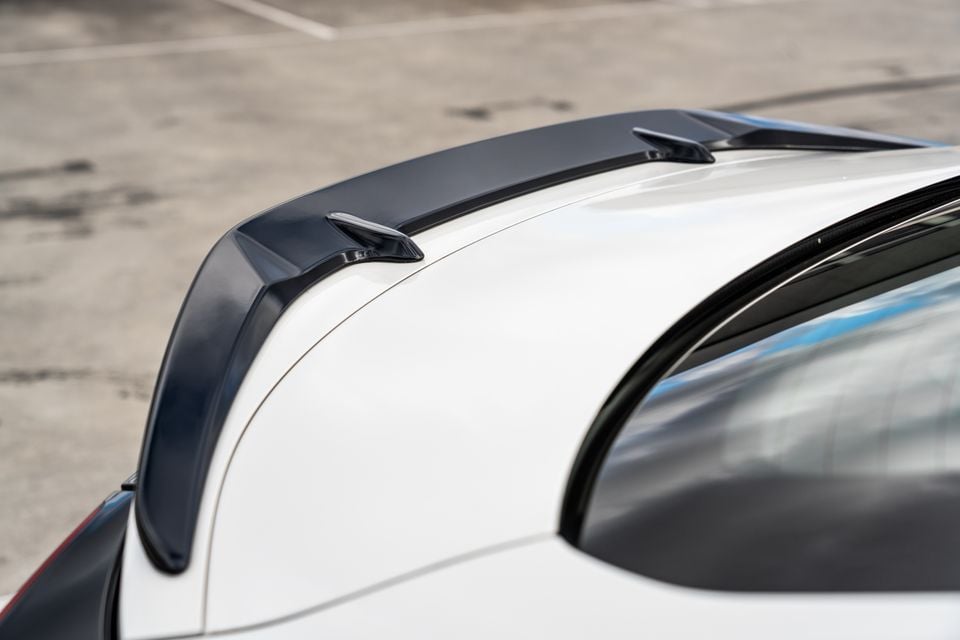
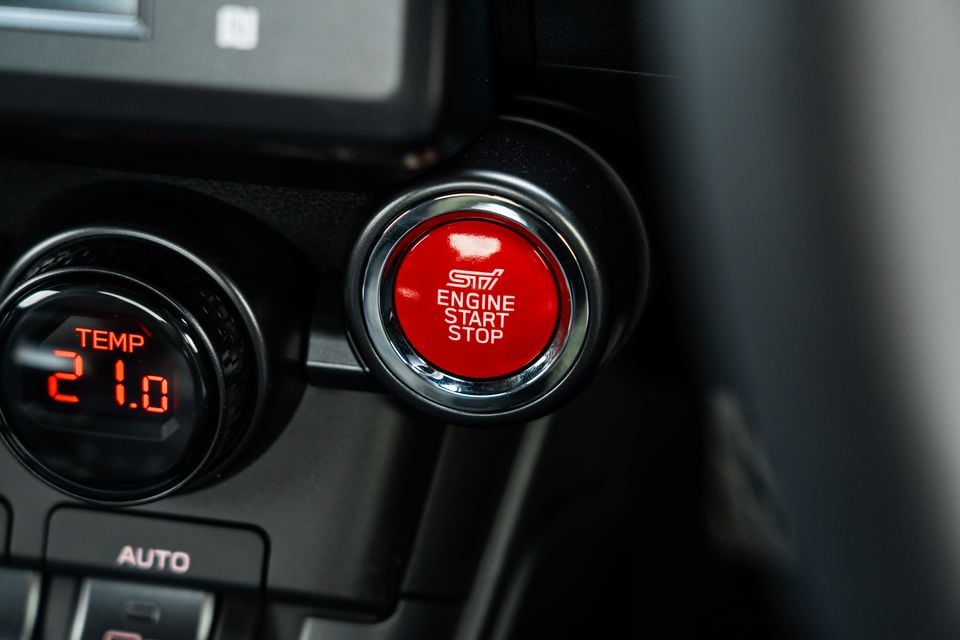
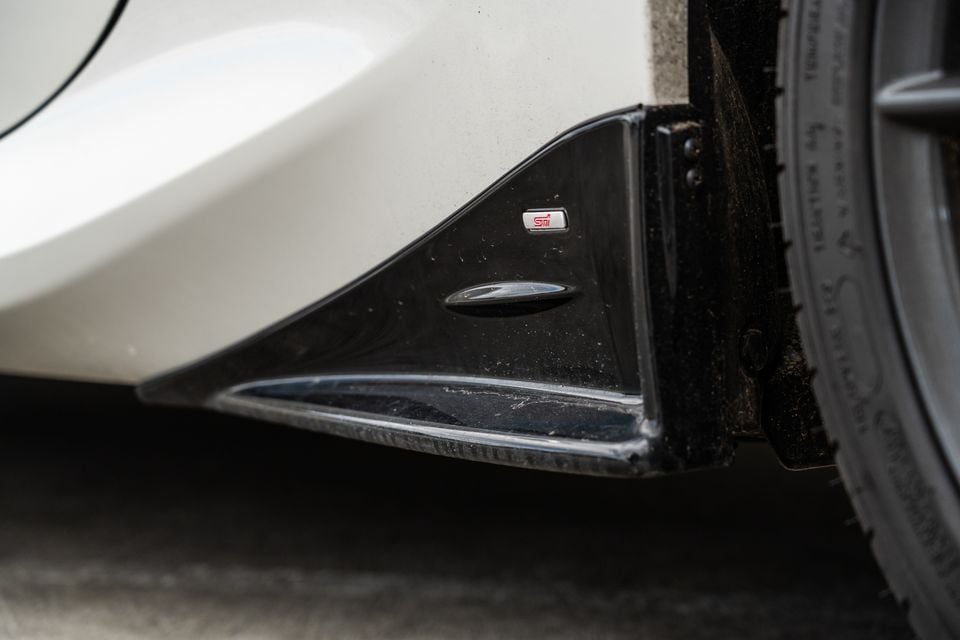
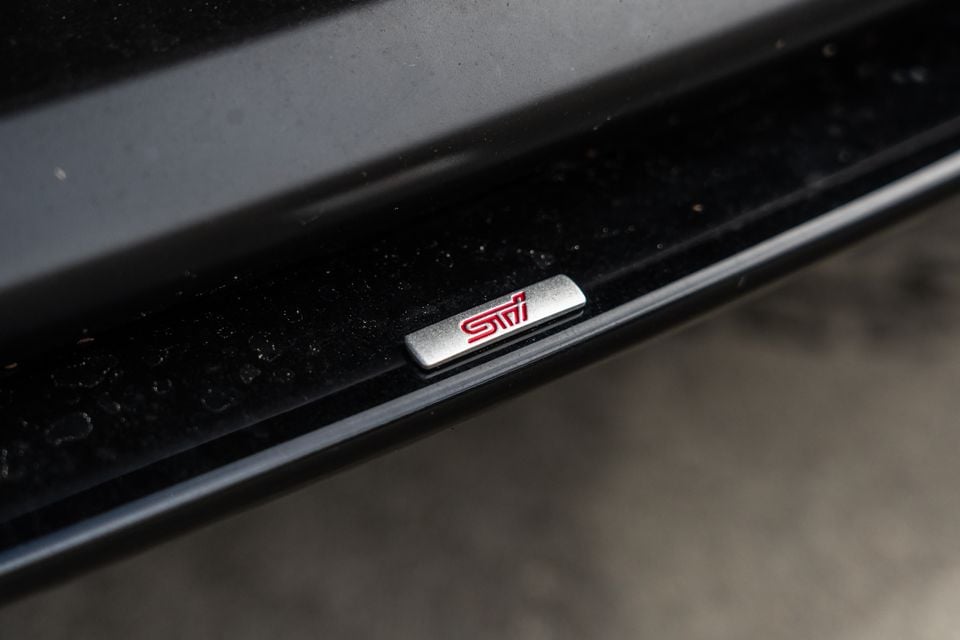
As for our tester, it was fitted with several genuine accessories and finished in no-cost Crystal White Pearl. The as-tested accessories – totalling $5263.25 – are as follows:
To see how the Subaru BRZ stacks up against the competition, check out our comparison tool
Subaru is far from the most technologically advanced automaker out there, but it’s still surprising to find that the BRZ's interior is very old-school.
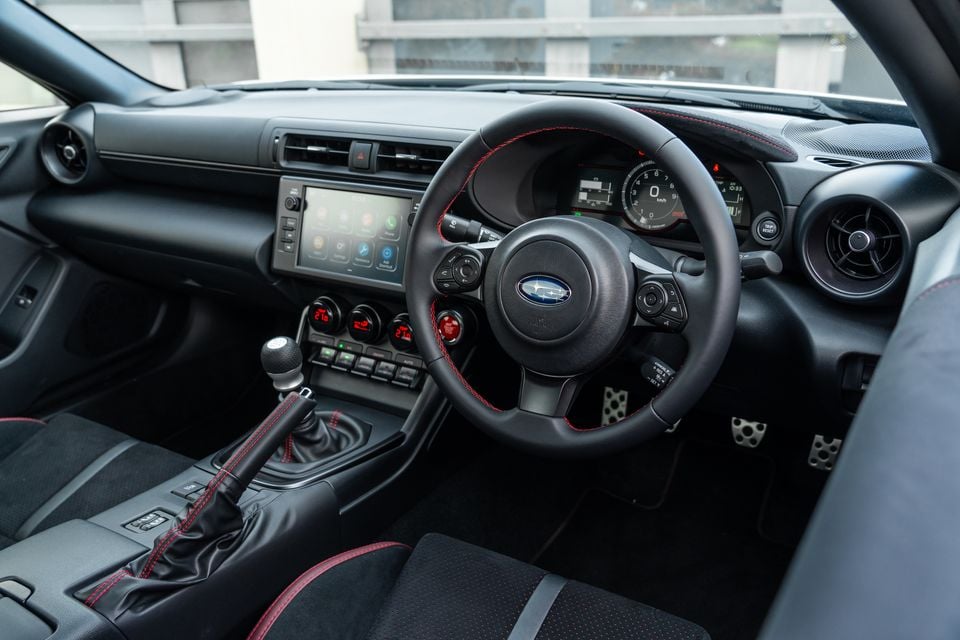
You can reasonably argue that the MX-5's interior has a similar vibe, but it's traditional in a different way from the BRZ, probably because Mazda's roadster is now also 11 years old. Subaru's older feel seems much more like a conscious decision than just the result of age.
Whether that's a good thing depends on who you ask. On the one hand, it's difficult to defend things like wired-only Apple CarPlay, a generally old infotainment system, and the chronic lack of places to put things. It's all very 'previous-generation' Subaru.
But on the other hand, the fact the BRZ is unashamedly basic inside allows for more focus on nailing the things that matter in a lightweight sports car to enthusiast driver. The driving-related tech is basic but intuitive and functional, the ergonomics are spot-on, and everything else feels as solid as it needs to.
Let's start with that tech. The item drivers will interact with most is the 7.0-inch display in the instrument cluster, which is among the most basic displays we've seen in any digital cluster setup.
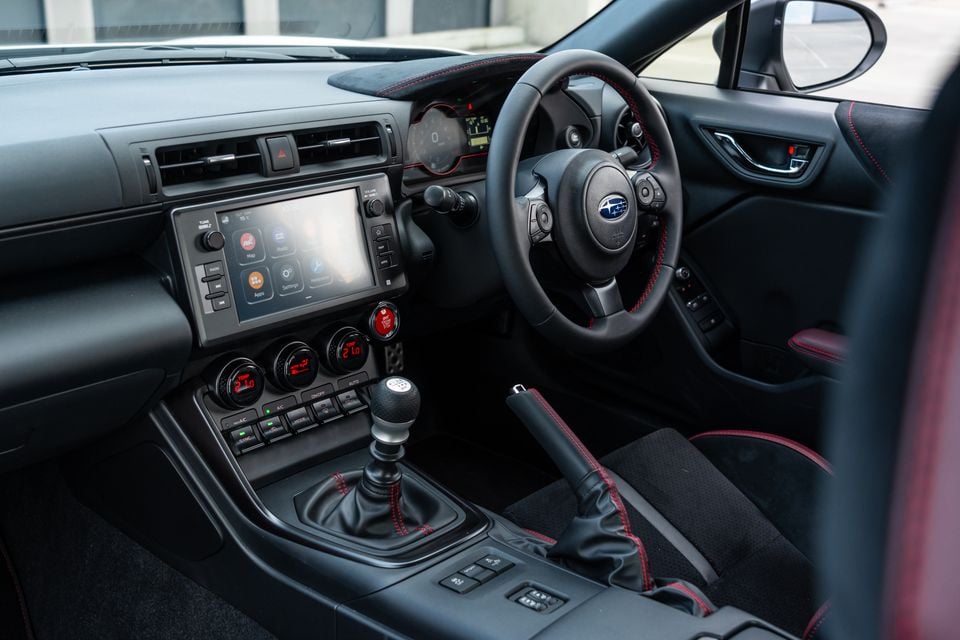
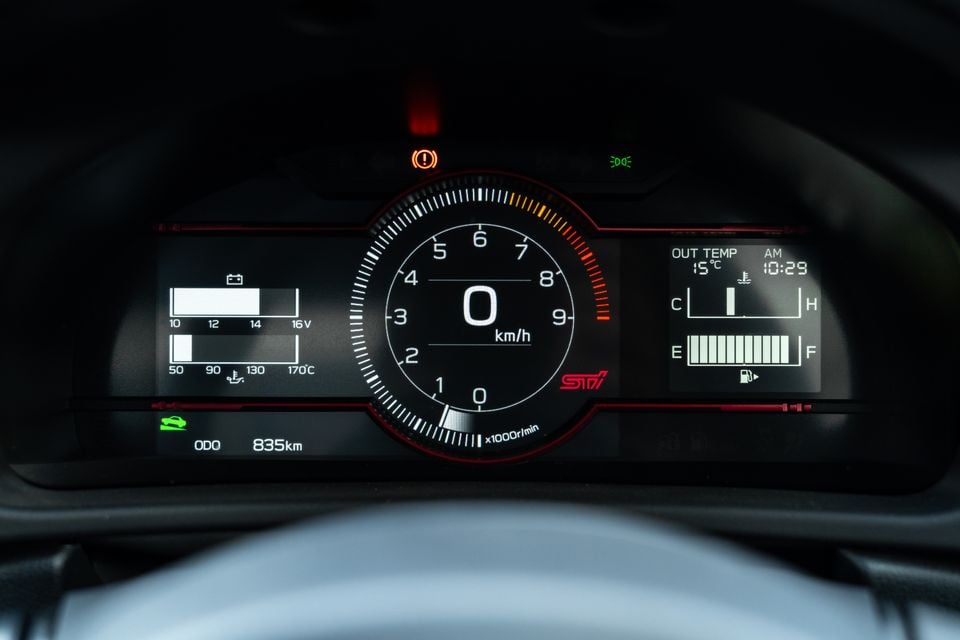
It's something of a hybridised display, because it operates much more like a traditional gauge cluster. That means it’s never going to confuse the driver, even if it is a clear step above an old-school LCD readout.
Its graphics are edgy yet simple, and the little customisation it does offer is easy enough to figure out. Directional buttons on the right of the steering wheel will open a small settings menu on the left of the display, where you can adjust basic safety settings and the like.
A neat trick here is the ability to not only toggle an audible shift indicator, but also adjust where in the rev range it beeps. That should cater for both racetrack fanatics and casual drivers wanting a bit of performance flair.
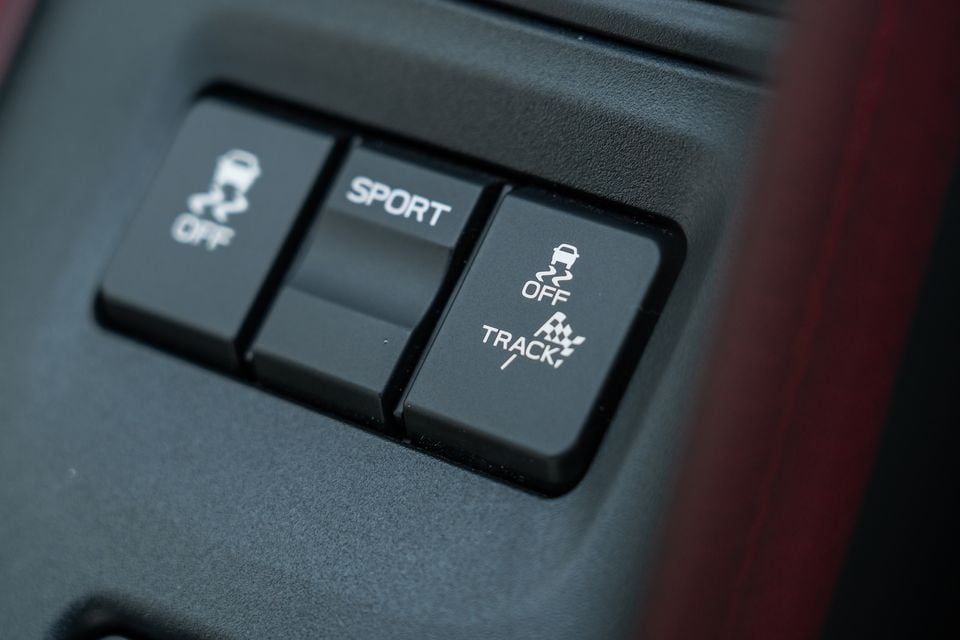
The orange portion of the tachometer displays your set indicator, while the red portion remains fixed at the car's remarkably high rev limit. Enabling Track mode with the button on the centre console switches the display to a horizontal rev counter with a large gear indicator, keeping the important things in focus during high-intensity driving.
We quite like this approach, as it's an example of Subaru prioritising the driver over flashy tech. The only embellishment on this screen is the STI logo off to the side – a subtle touch, if not a bit frivolous.
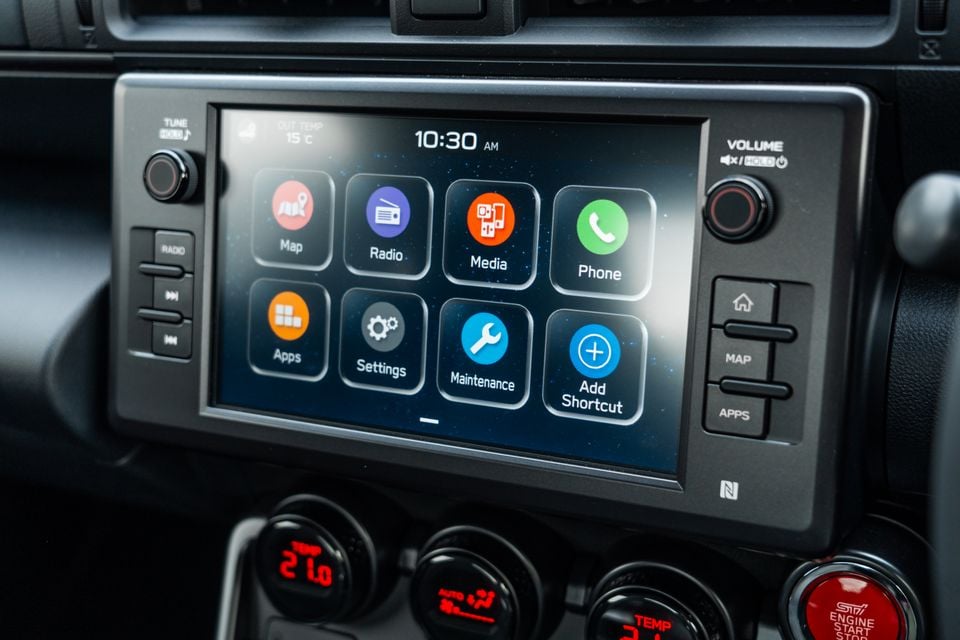
The only other tech in the BRZ's cabin is the 8.0-inch touchscreen infotainment system. With its thick plastic bezels and small array of physical shortcut buttons, this is arguably the single most dated item in here.
That's evidenced by its fairly low resolution and the fact it only offers wired smartphone mirroring. At least that physical connection seems to be reliable, and we found the screen responsive enough for comfortable use.
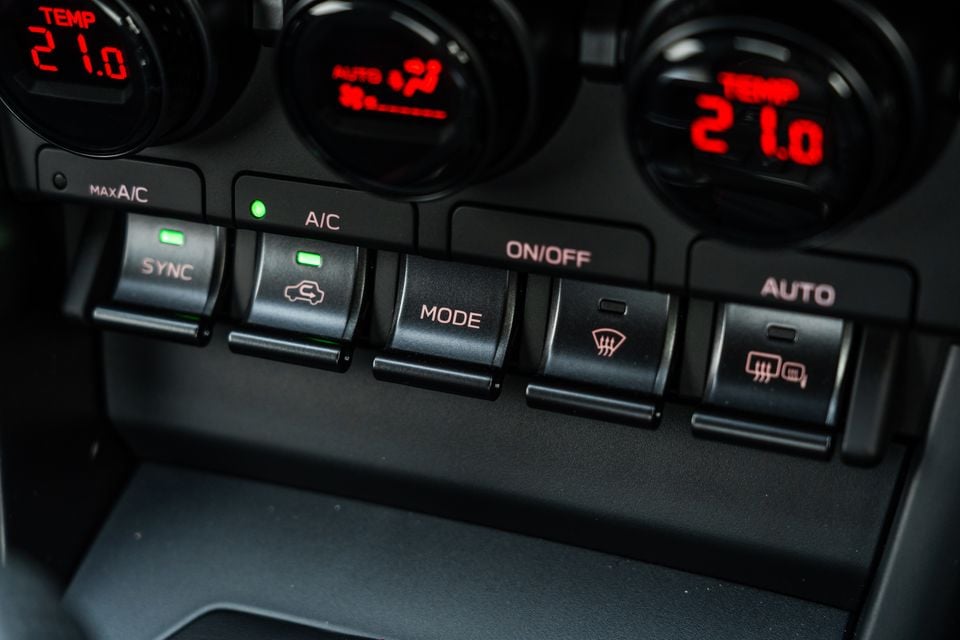
It’s clearly a Subaru unit, though; the starry background and glassy icons are a dead giveaway. We still find the BRZ’s cabin tech nicer to interact with than the WRX's, primarily because it has notchy dials and chunky switches for climate control, making it feel satisfyingly traditional.
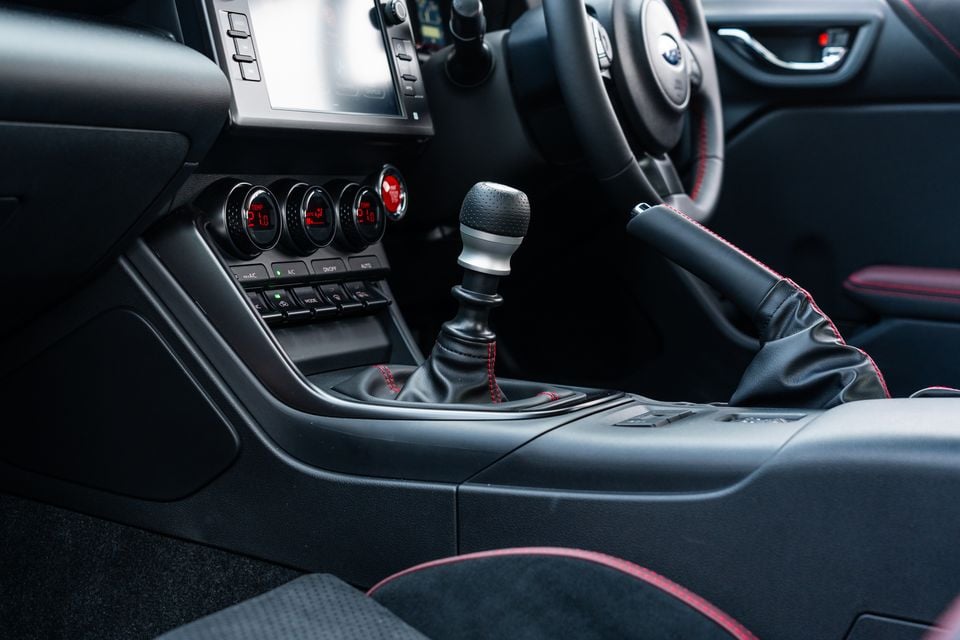
It’s also worth mentioning the sound system isn’t heinous for a non-branded unit. A Harman Kardon setup consistent with other high-spec Subarus wouldn’t go amiss, but we found the standard system generally acceptable, though naturally lacking punch across the range.
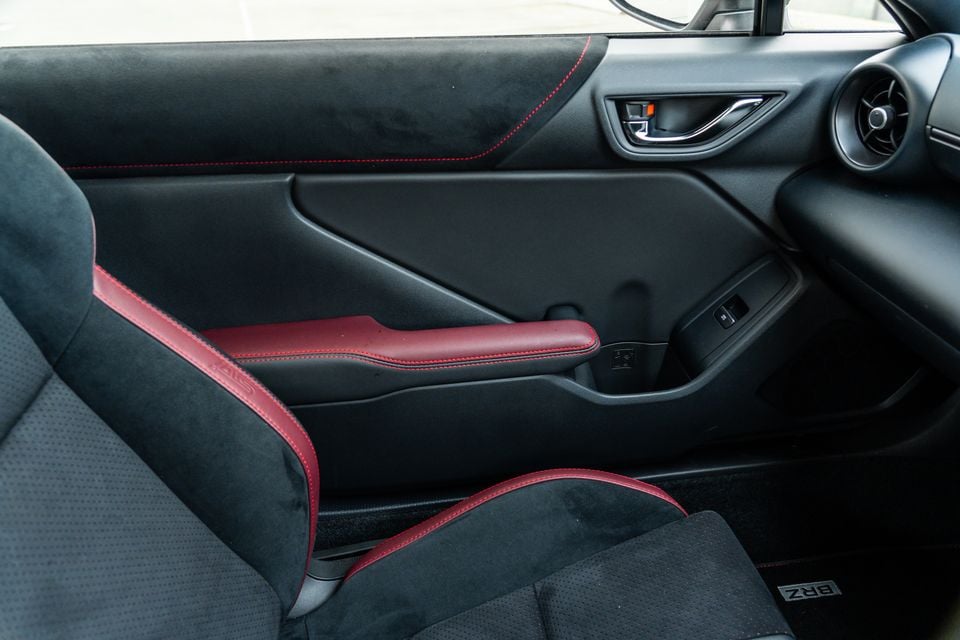
Beyond all that, the ergonomics are a real highlight. The sports seats – featuring embossed STI logos on the wine-red accented bolsters – strike a perfect balance between daily comfort and performance driving support. They're also positioned as low as you'd want in a car like this.
Expect them to feel tight if you’re on the larger side, though that’s true for the cabin as a whole. Unsurprisingly, adjustment is only manual, but you do get two-stage seat heating operated via very basic switches on the centre console.
The steering wheel, meanwhile, is another item that suits the BRZ’s character to a T. Its rim is thin, providing a lightweight feel in the hands to match the lightweight nature of the car, and its leather wrap is a bit of luxury.
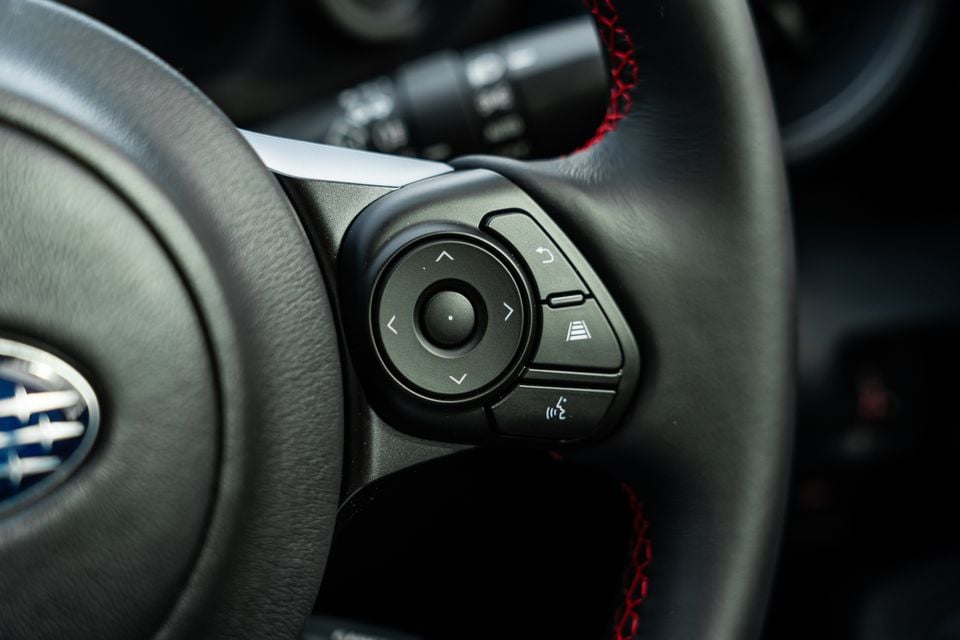
While its buttons and controls may look dated, especially the dorky cruise control stalk taken straight from a 2010 Corolla, we found them easy to understand and use.
Other items, like the manual shifter and its optional STI-branded knob, fall nicely to hand, and we love that the BRZ still has a manual handbrake. The pedal box isn't cramped either, with hardly any intrusion from the transmission hump.
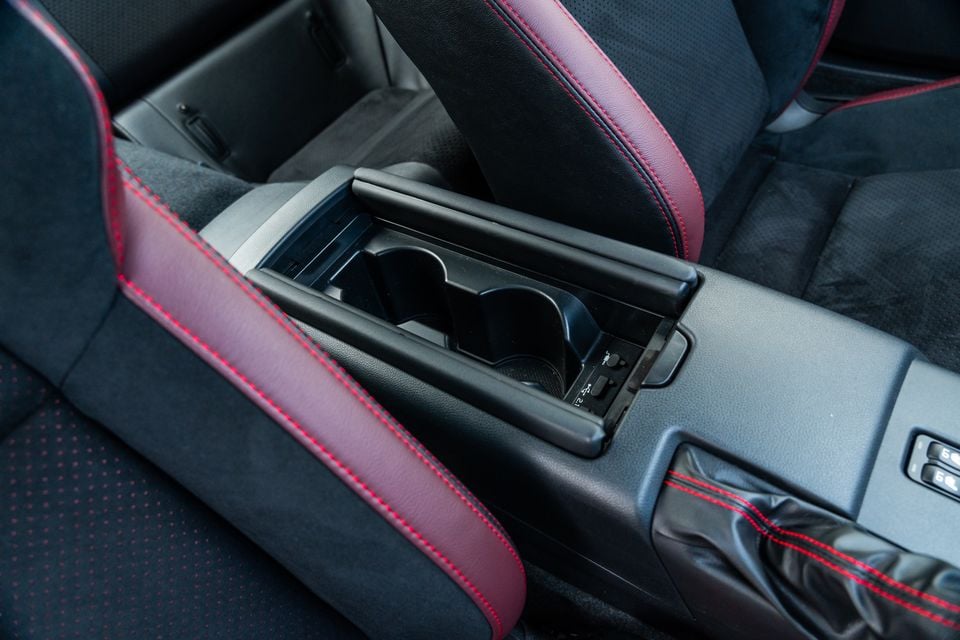
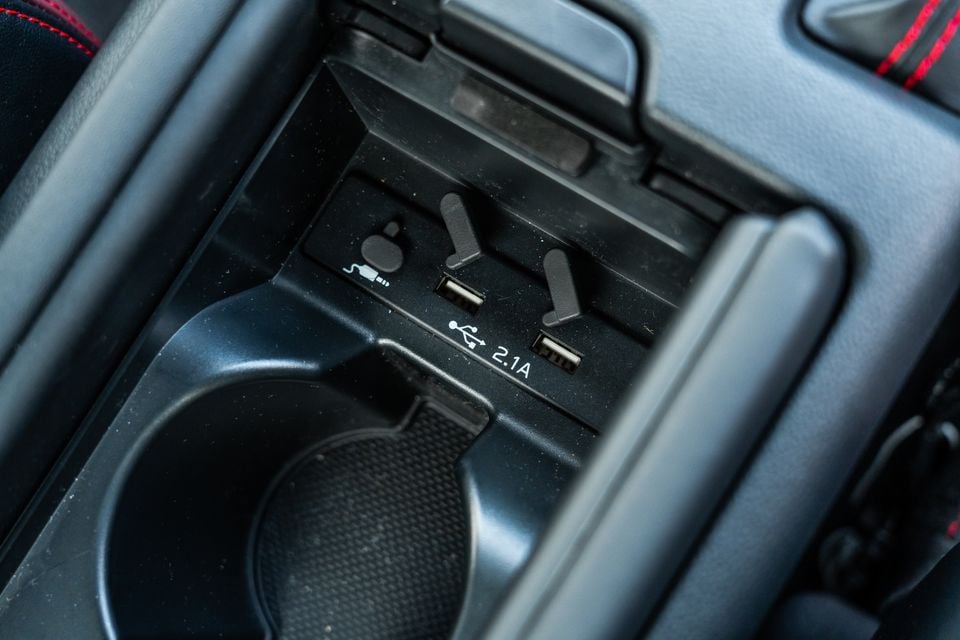
As mentioned, though, storage is a weak point. The only real place to put things for quick access is the lidded cupholder compartment on the centre console, which offers a slot for your phone when it’s plugged into either of the USB-A ports also found here.
But placing a phone there will block the cupholders, and there’s no real alternative. At least the MX-5 gives you a pair of removable cupholders between the seats, as well as a shallow lidded cubby on the centre console and a phone-sized slot ahead of the shifter.
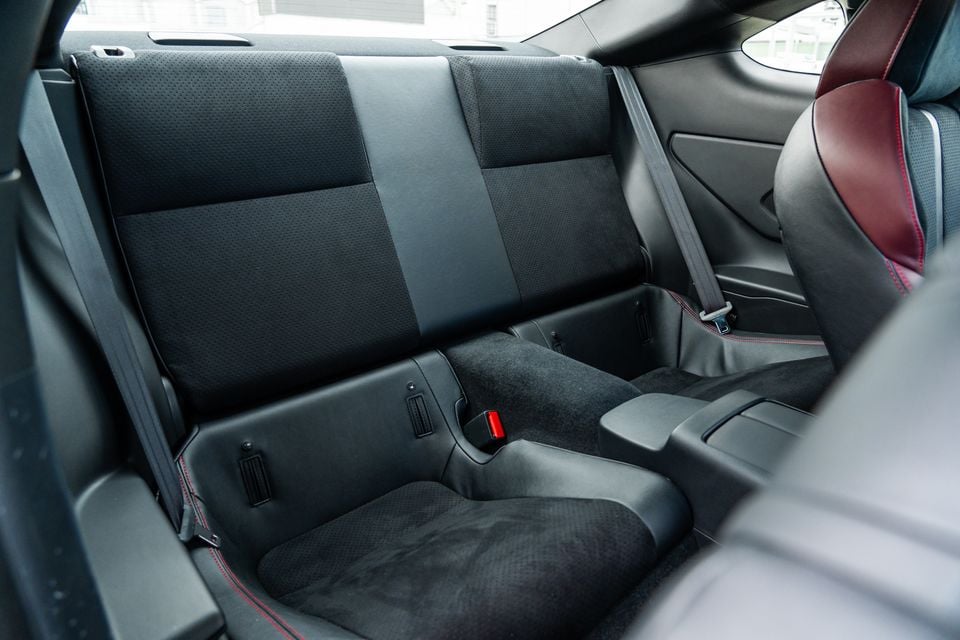
You do still have a passenger-side glovebox and storage cubbies in the door cards (unlike an MX-5), but both are very compact. Of course, the BRZ gains some extra flexibility by including rear seats.
Mind you, ‘seats’ is a generous term, because they really aren’t designed for adults. Children could just about get by back here, but it’s very much at the limit of what could be considered a four-seater. At least the two positions are very buckety and sculpted.
If you do need to get people in for a short trip, it’s easy enough to slide the front seats forward to enable the contortionist act required for entry. Second-row space is still best utilised by backpacks and other small items, and the bench can fold down to increase boot space.
Access to the boot is granted by either a small button hidden within the black bar across the tailgate or a dashboard button to the right of the steering wheel. The storage area back here is surprisingly large for the size of the car.
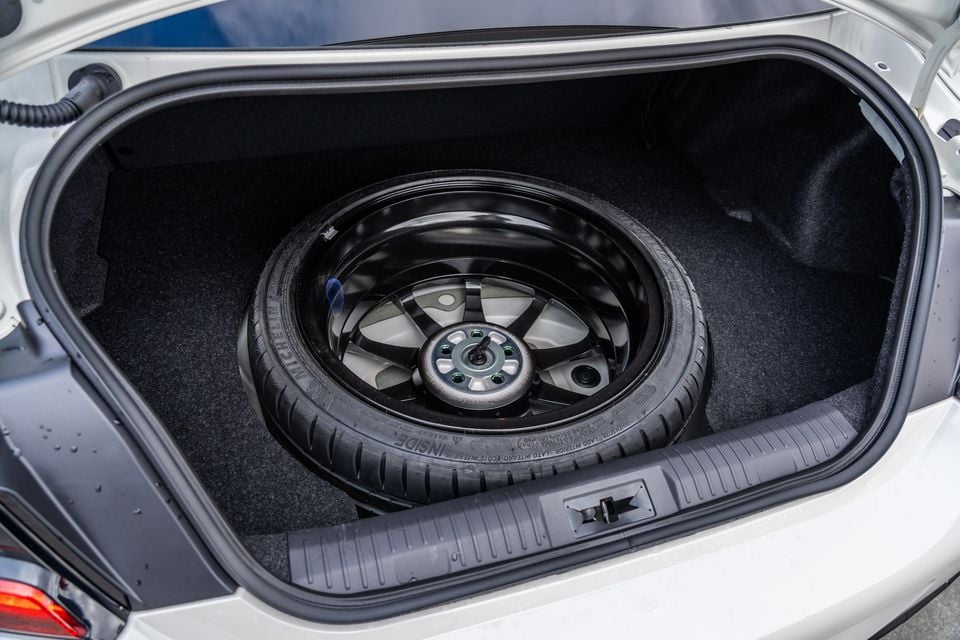
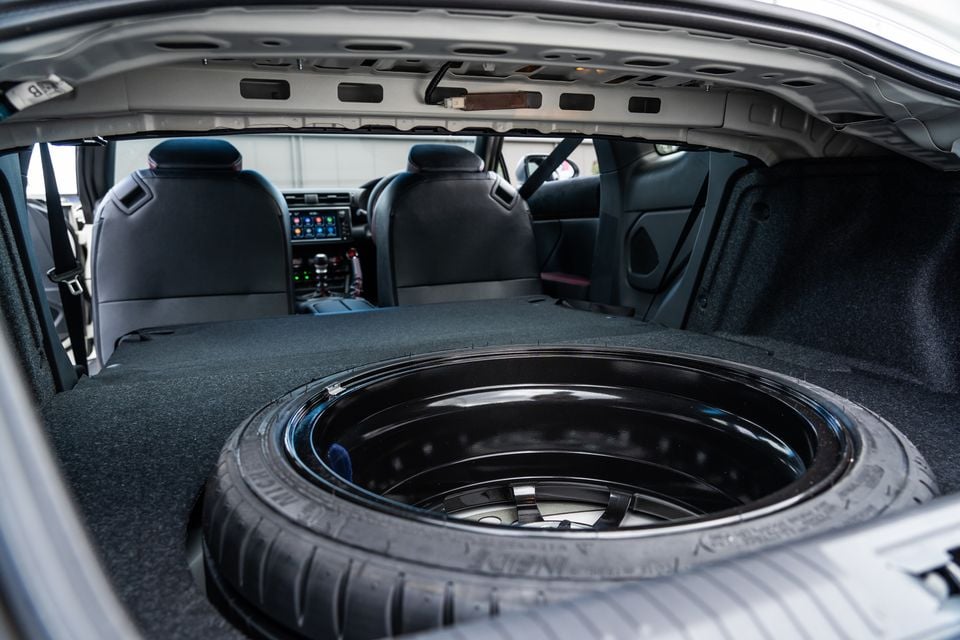
Fascinatingly, much of it is taken up by a full-size alloy spare. It’s actually incredible that Subaru offers this here given it tends to prefer space-savers in cars far larger than this.
We didn’t find it prohibitively intrusive, either, as the fact that the wheel is mounted face-down means you can load some cargo into its barrel. You can also ‘hide’ it with an optional wheel cover.
We’ll again nitpick by asking for a small handle inside the bootlid to close it without touching the exterior paintwork – something Subaru has neglected in its coupes and sedans for quite some time. Even a tiny plastic fitting would suffice.
But all told, the BRZ offers one of the best modern interiors for fans of more traditional sports cars, and that’s more refreshing than ever in an age of minimalism and iPads. There’s just one thing – our tester has perhaps a few too many STI logos for a Subaru that isn’t a full-blown STI.
| Dimensions | Subaru BRZ tS |
|---|---|
| Length | 4265mm |
| Width | 1775mm |
| Height | 1310mm |
| Wheelbase | 2575mm |
| Cargo capacity | 201L |
To see how the Subaru BRZ stacks up against the competition, check out our comparison tool
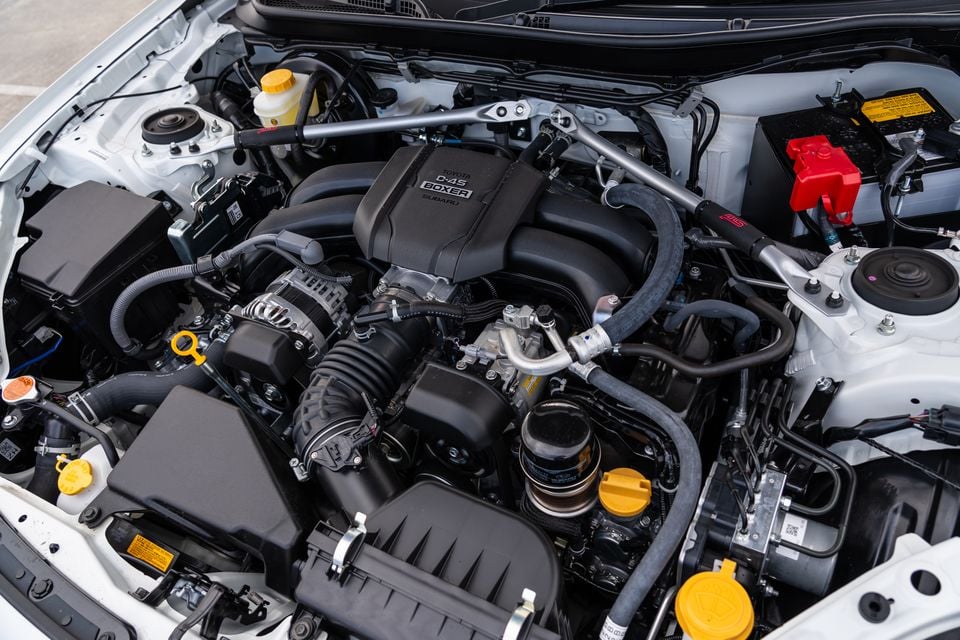
Powering the BRZ is a 2.4-litre naturally aspirated four-cylinder 'Boxer' engine producing 174kW of power and 250Nm of torque. Drive is sent to the rear wheels via either a six-speed automatic or, in the case of our tester, a six-speed manual transmission.
| Specifications | Subaru BRZ tS manual |
|---|---|
| Engine | 2.4L 4cyl 'Boxer' petrol |
| Power | 174kW |
| Torque | 250Nm |
| Transmission | 6-speed manual |
| Drive type | RWD |
| Tare weight | 1256kg |
| Fuel economy (claimed) | 9.5L/100km |
| Fuel economy (as tested) | 9.7L/100km |
| Fuel tank capacity | 50L |
| Fuel requirement | 98-octane premium unleaded |
| CO2 emissions | 217g/km |
Annoyingly, Subaru does not publish a claimed 0-100km/h time for the BRZ. Previous testing of a 2022 model on the CarExpert YouTube channel, however, recorded a 6.88-second sprint time.
Our week with the car involved a mix of highway commuting, urban driving, and a fair chunk of the requisite hard driving at higher speeds. The recorded fuel economy may be high in the context of a vehicle this small, but it's not that far off what we recently recorded in the MX-5.
However, a key caveat is that the BRZ drinks pricier 98-octane fuel, whereas the Mazda will happily run on 95-octane premium unleaded.
To see how the Subaru BRZ stacks up against the competition, check out our comparison tool
This is truly where the BRZ proves its worth.
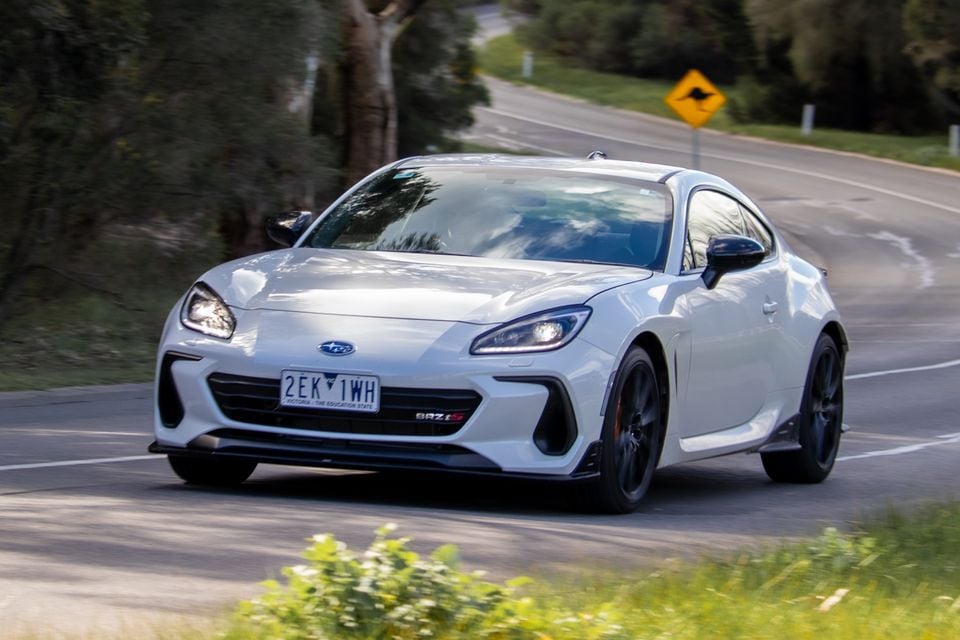
Of course, the lightweight rear-drive sports car formula is nothing new. Where the BRZ shines is in just how complete a package it is, especially in tS trim, because it’s clear Subaru has taken great care to improve on only the things that round out the driving experience as best as possible.
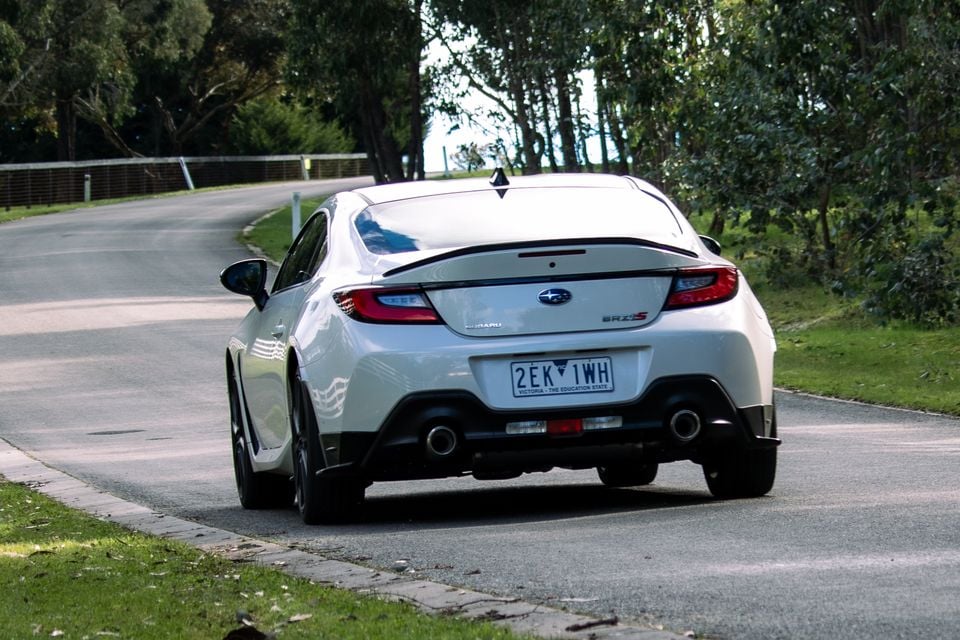
Take the suspension. The STI-tuned dampers bring clear improvements to overall on-road behaviour over the ‘normal’ setup in other variants, primarily because it feels just as well-sorted in typical commuting as it does on a winding B-road.
Yes, it’s firm, but it doesn’t crash over bumps or send jolts up your spine. Instead, it demonstrates good compliance on typically rough Victorian roads, with a good range of well-managed suspension travel to keep the cabin relatively comfortable.
The MX-5, specifically in Bilstein-equipped GT RS trim, does much of the same, but it feels as if it rides slightly higher and has a fraction more body movement. We suspect the extra weight of the BRZ helps keep the dampers loaded and therefore more controlled.
If this is the car for you, we’ll compare offers from trusted dealers, handle the back and forth and manage your purchase from enquiry to delivery.
Then there’s the steering, which offers no customisation for its weight or feedback. Fortunately, it’s bang-on for a car like this, giving you solid feel and communicative response that makes the BRZ approachable and easy to learn.
It also has fairly quick steering, not too dissimilar to STIs of old, making this already lightweight, nimble chassis feel all the more agile. Again, it isn’t a true STI, but the influence is noticeable if you know where to look.
Other tS items include the Brembo brake calipers, painted a lovely metallic gold. Though the benefits of the fixed calipers (four-pot front and two-pot rear) won’t necessarily be obvious in normal driving, aside from strong pedal feel, they should be more consistent than the floating calipers in other BRZs when you push the car harder.
And, of course, the clutch is light-ish and easy to live with thanks to its logical bite point, and the manual shifter is brilliant. It’s direct, with a relatively short throw, and satisfying to use, while the optional STI knob adds a tiny bit of weight for a more solid feel.
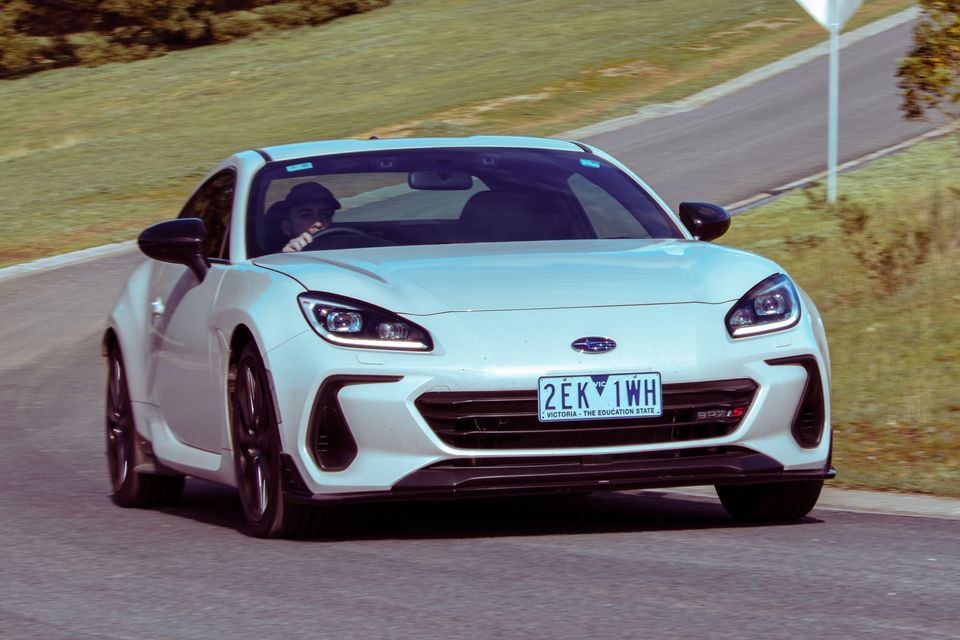
But most important is how everything comes together when you hit a bendy road. In such a scenario, the BRZ tS is eager, characterful, and more than happy to play along at whatever level of intensity you're comfortable with.
Its handling and body control are genuinely superb. Those tS dampers keep body roll down to great effect, and it feels more stable than the slightly wobblier MX-5, generating confidence as the speed picks up. Understeer is also difficult to induce if you're smooth at the helm.
It definitely isn't glued to the road, though, and minor steering corrections will be necessary through corners. That isn't a flaw, however; rather, it reminds you how playful this car can be. You can even use that characteristic to your benefit if you're prepared.
You'll find that the small amount of rear-end movement allows you to pivot the car early on corner entry. Do that with confidence, and the car is more than happy to bite into the road, hunkering down and carrying great speed on the correct line.
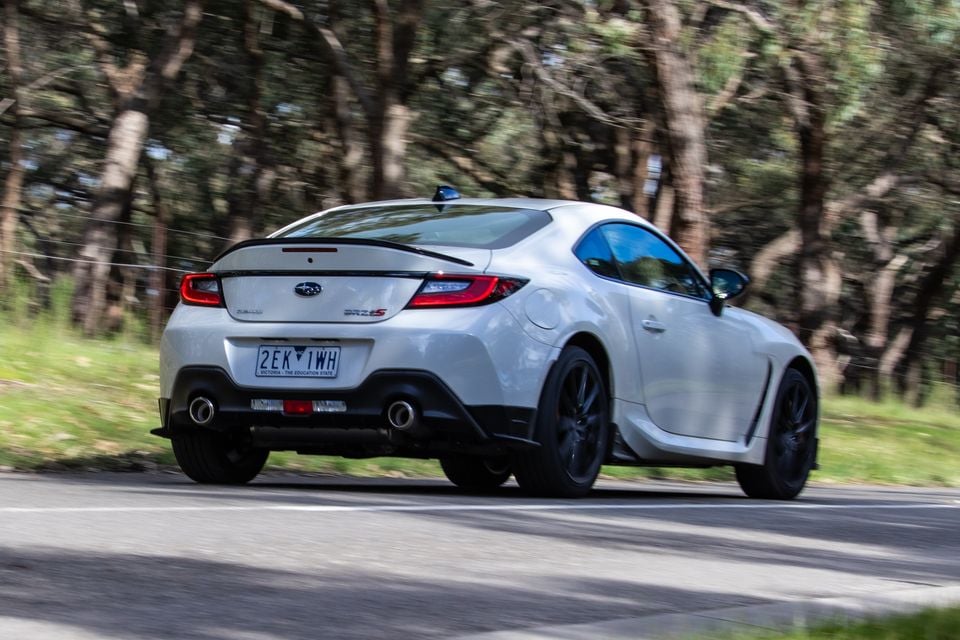
While the MX-5 is also a great-handling, well-balanced vehicle, its playful quality appears far more whimsical. It's meant to be a little wilder, contrasting the BRZ's tendency to be more controllable and predictable – we'd argue it has greater overall grip and is generally more mature, and that may have something to do with its fixed roof.
Anyway, the BRZ can be joyous on higher-speed country roads with gentler bends, but we think it's at its best when the road gets tighter. There are many reasons for this, though the main one is that narrow roads with sharp turns are where the rear-drive layout shines.
It happily darts into low-speed bends with that agile character, staying planted until you hit the throttle, after which it'll happily wag its tail as you accelerate away. This is even better in Track mode, which relaxes traction and stability control, while Sport mode sharpens throttle response.
This is where that controllable, predictable nature comes into play. Any slip is incredibly easy to manage, and the car obediently slots back into line with a dose of opposite lock. The conservative power levels also mean it's unlikely to get too wild.
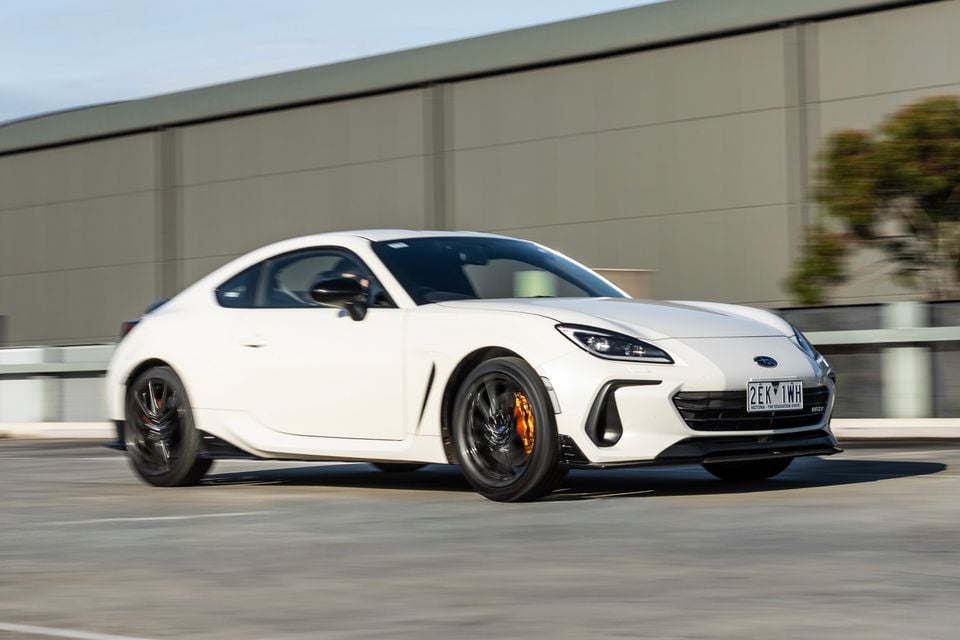
And that leads us on to the powertrain. To nobody's surprise, the BRZ is no powerhouse, which is why tighter roads at lower speed tend to feel more natural for it. Similarly, the short gearing helps it feel spritely off the line, but it also holds a grating 3000rpm in sixth gear at 110km/h.
Truth be told, the BRZ doesn't need more power, let alone a turbo. The 'FA24' boxer in the current model is a near-perfect match for this application, with its linear power delivery, appropriate outputs, and high redline. It's far better than the previous generation's engine, and at its best with a manual.
However, throttle pedal response is lacking. There's significant lag, which, coupled with some not-so-subtle rev-hang, makes smooth shifting difficult. It's at its worst if you're driving with say, 'medium' aggression, but it does feel better at either end of the intensity spectrum. Sport mode helps sharpen things, too.
It still makes smooth downshifts a bit of a chore, which is a pain given there's no automatic rev-matching. This throttle calibration will be a stark point of difference for those familiar with the more intuitive older WRXs, especially STIs, even if this is a very different car.
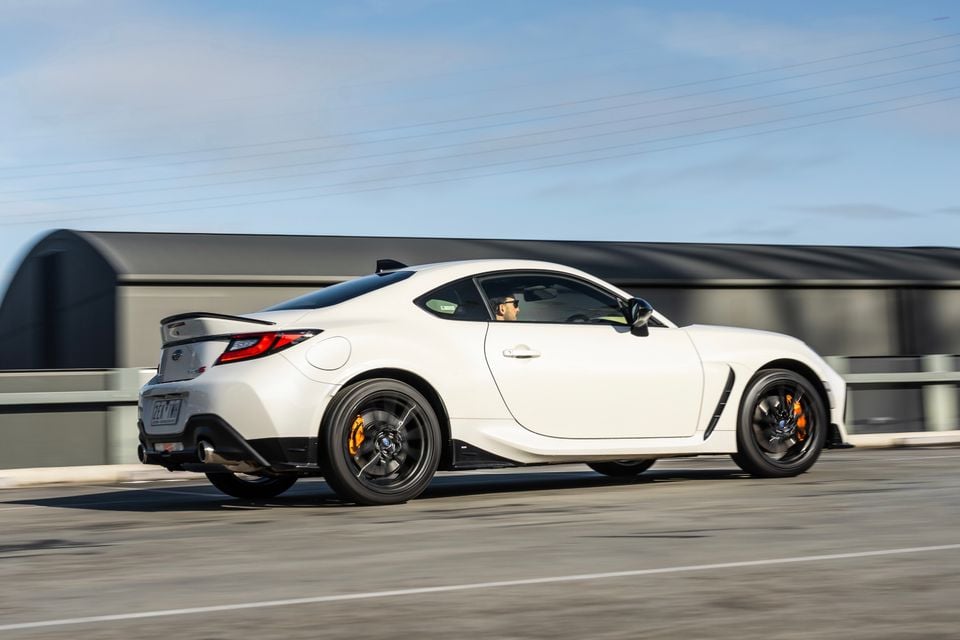
Day-to-day, the BRZ is workable in terms of ride quality, but refinement is subpar. The high RPMs at freeway speeds means the engine isn't exactly quiet – less so with Track mode's artificial engine sound amplification – and there's quite a lot of road noise. These are par for the course in any basic sports car.
Offsetting that is a reasonable suite of safety gear to help you along. Blind-spot monitoring is reliable (BRZ/GR86 blind spots are no joke), adaptive cruise works fine but lacks lane-centring, and the lane-departure warning only beeps if you actually cross the line.
Forward collision warnings, however, can be too sensitive, and despite being a top-spec trim, the manual tS doesn't get any parking sensors. You have to buy an automatic to even get rear sensors, and front ones aren't available at all. Bizarre.
All told, the BRZ is pretty much as good as it gets for a 'basic' sports car, provided you prefer a more planted, predictable dynamic setup. Though not revolutionary, the STI-flavoured enhancements of the tS also justify the extra outlay.
To see how the Subaru BRZ stacks up against the competition, check out our comparison tool
The Subaru BRZ is available in three trim levels.
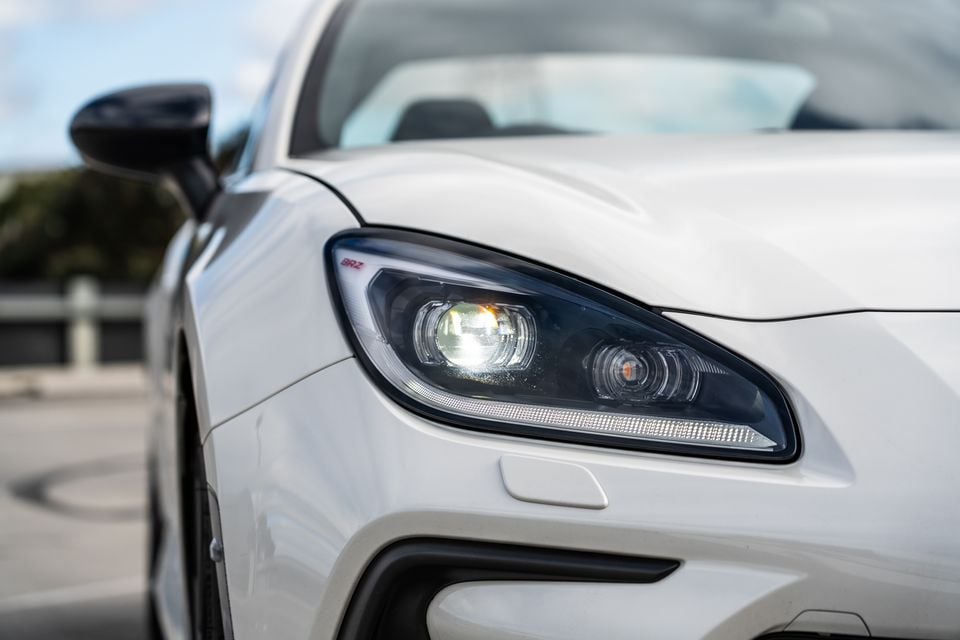
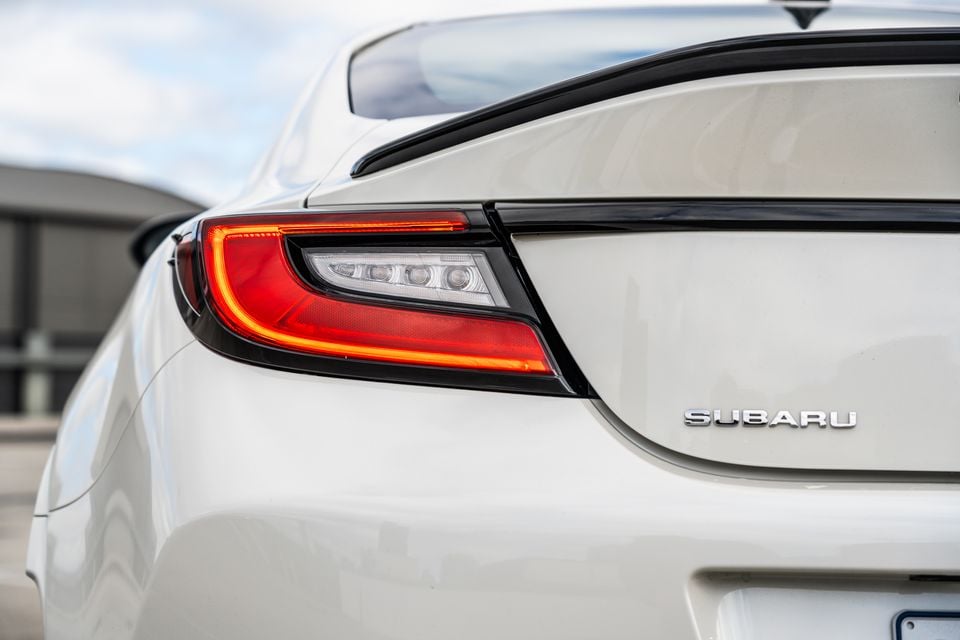
2026 Subaru BRZ equipment highlights:
BRZ S adds:
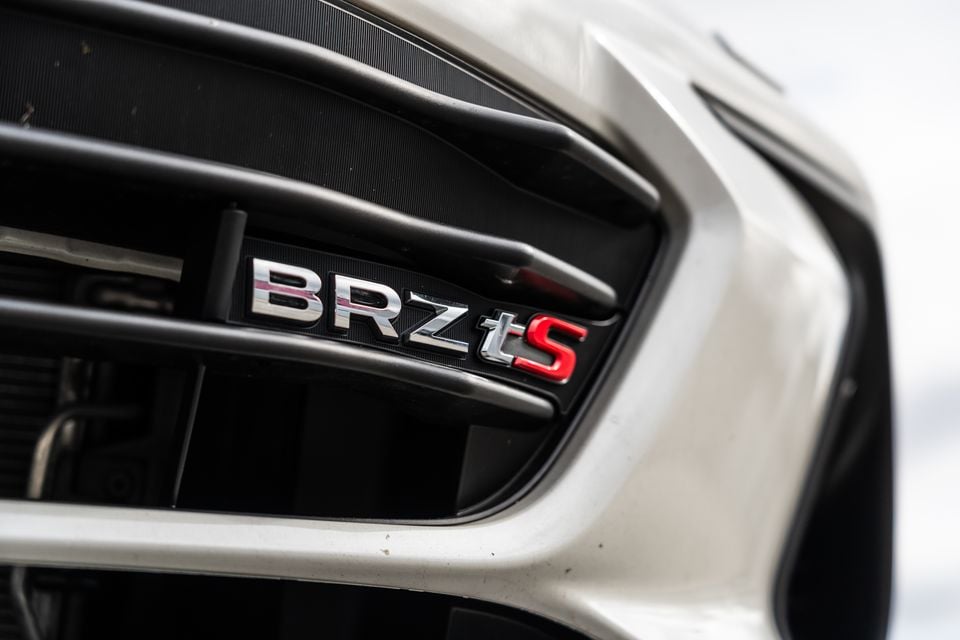
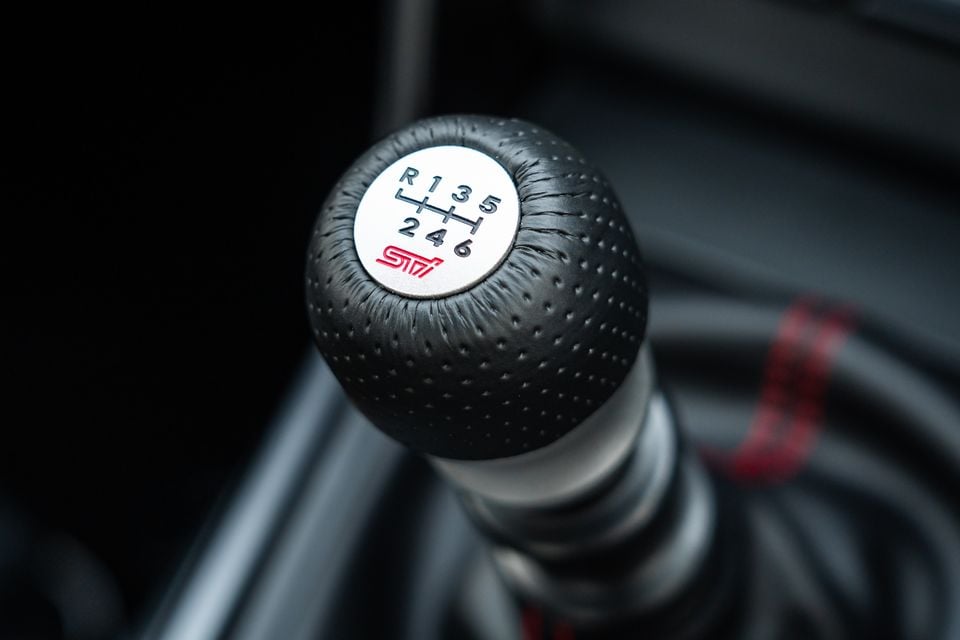
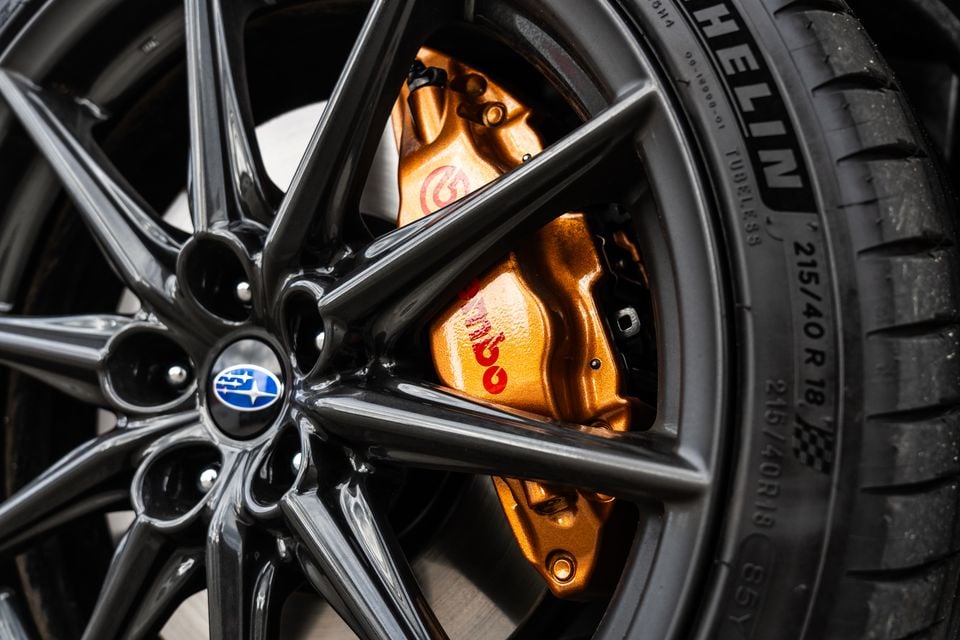
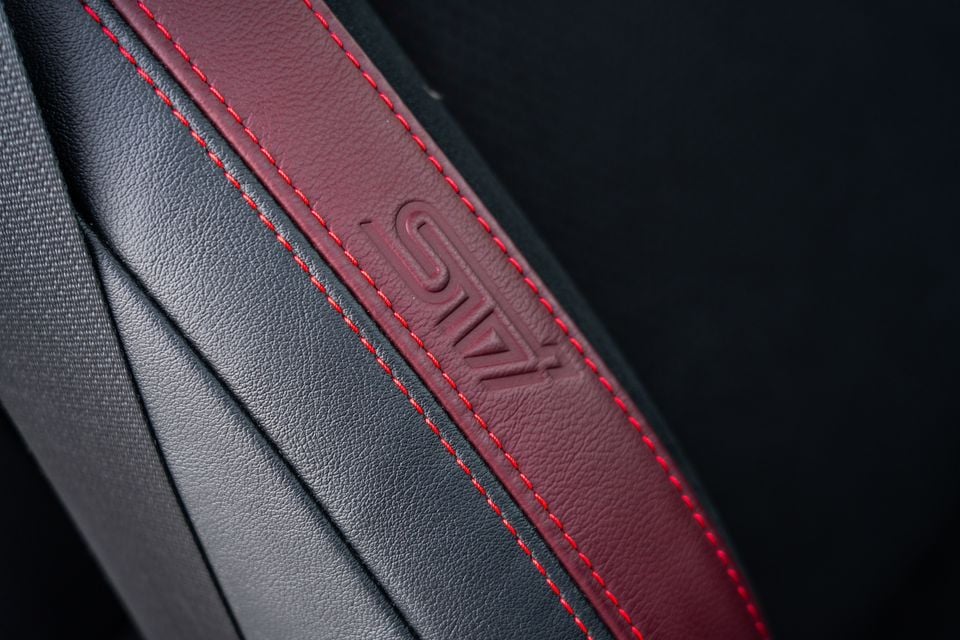
BRZ tS adds:
To see how the Subaru BRZ stacks up against the competition, check out our comparison tool
The current-generation Subaru BRZ has not been crash-tested by ANCAP and is therefore unrated.
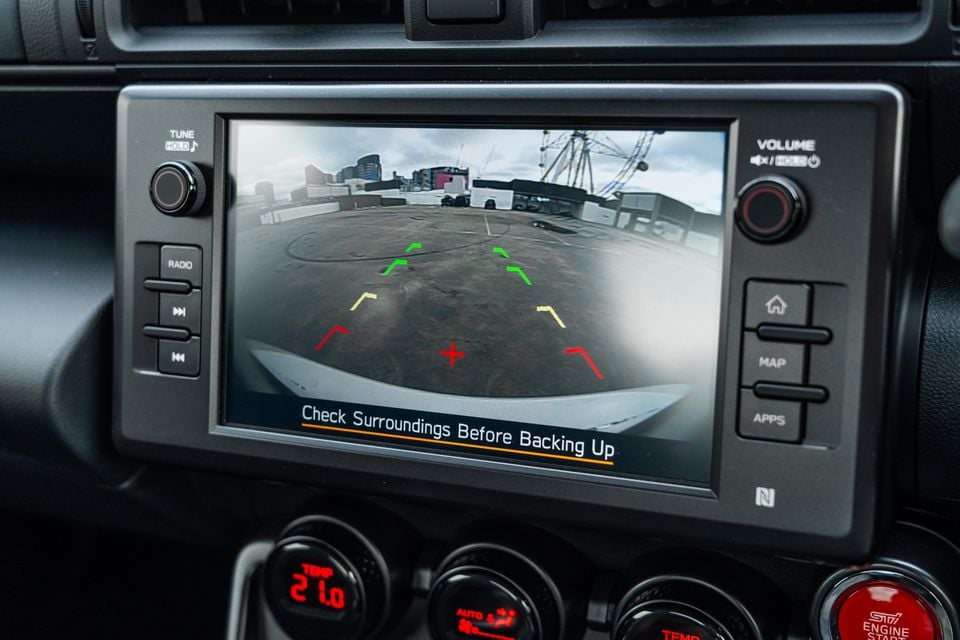
Standard safety equipment highlights:
To see how the Subaru BRZ stacks up against the competition, check out our comparison tool
Subaru Australia backs its range with a five-year, unlimited-kilometre warranty. Servicing for the BRZ is required every 12 months or 15,000km, whichever comes first, but prices differ slightly between manual and automatic vehicles.
| Servicing and Warranty | Subaru BRZ |
|---|---|
| Warranty | 5 years, unlimited kilometres |
| Roadside assistance | 12 months |
| Service intervals | 12 months or 15,000km |
| Capped-price servicing | 5 years |
| Average annual service cost | $512.77 – manual $488.49 – auto |
| Total capped-price service cost | $2563.85 – manual $2442.45 – auto |
Subaru's individual service costs are detailed below:
| Service | Price (manual) | Price (auto) |
|---|---|---|
| 12 months, 15,000km | $368.30 | $362.89 |
| 24 months, 30,000km | $625.97 | $620.79 |
| 36 months, 45,000km | $450.34 | $446.50 |
| 48 months, 60,000km | $740.34 | $638.79 |
| 60 months, 75,000km | $378.90 | $373.48 |
Toyota's capped-price service program comprehensively undercuts Subaru's maintenance costs. Five years of servicing for the GR86 will cost a total of $1675.
MX-5 maintenance, meanwhile, is more expensive than both. Mazda outlines a total five-year service cost of $2862.
To see how the Subaru BRZ stacks up against the competition, check out our comparison tool
In a market where same-same commuter cars are very much front of mind, it's increasingly refreshing to drive vehicles that are simple, (relatively) affordable, and undeniably fun. The BRZ fits the brief brilliantly.
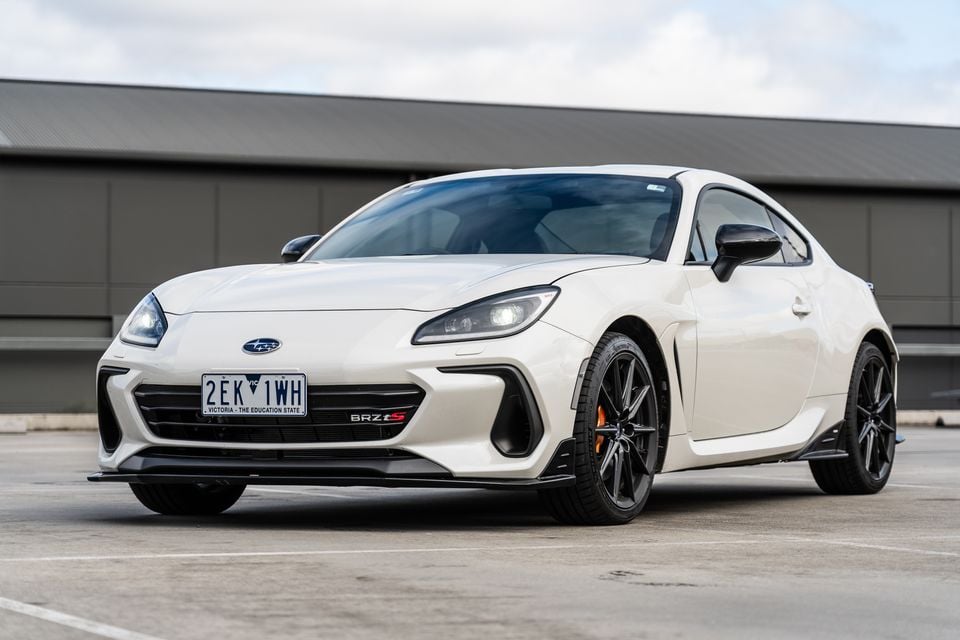
It's a low-slung coupe with appropriate levels of power and just enough spice to keep you interested; a sporty car that does all the things a sporty car should. It isn't trying to be anything particularly flashy or new-age, but it's all the better for it.
In fact, our favourite thing about the BRZ is just how basic it is, because it means a positive driving experience is the priority. And its on-road behaviour is fantastic, particularly with the upgrades of the tS.
It handles well, it's stable, and most driving controls feel great. The brakes are a highlight thanks to good pedal feel, while its direct shifter action means you're unlikely to miss gears once the pace picks up.
We also like how lively it can be, and it's good that it responds diligently to driver inputs. That makes it predictable, and it won't bite you unless you recklessly exceed its dynamic limits.
Of course, nothing's perfect. We still want wireless smartphone mirroring so phones can stay in pockets given the lack of convenient storage, and some on-road aspects could be better.
Throttle calibration stands out, because there's just a touch more lag than we're prepared to overlook. It makes low-speed driving in urban environments more cumbersome than it needs to be, and it undermines the intuitive clutch operation.
It's also a shame that this particular BRZ lacks such basic safety gear as rear parking sensors. That's an odd contrast against the vastly more advanced 'EyeSight' system with autonomous emergency braking, even if that tech can be too sensitive with its warnings.
But at the end of the day, the BRZ remains true to the spirit of traditional lightweight sports cars, and you'd be just as satisfied if you saved a few thousand dollars on a lower grade than the tS. Its existence alongside the GR86 and MX-5 makes the new-car landscape just a bit more interesting.
CarExpert can save you thousands on a new Subaru BRZ. Click here to get a great deal.
Click the images for the full gallery
If this is the car for you, we’ll compare offers from trusted dealers, handle the back and forth and manage your purchase from enquiry to delivery.
Quickly see how this car stacks up against its competition. Select any benchmark to see more details.
Subaru BRZ
Subaru BRZ Sales rolling 12-months#
*Based on VFACTS and EVC data
Looking for complete Subaru BRZ price history?
Our Subaru BRZ Pricing Page shows exactly how prices have changed over time.
2026
$52,206
2026
$53,571
2026
$57,351
2026
$58,191
Max Davies is a CarExpert journalist with a background in regional media, with a passion for Japanese brands and motorsport.
Add CarExpert as a Preferred Source on Google so your search results prioritise writing by actual experts, not AI.
William Stopford
16 Hours Ago

Damion Smy
4 Days Ago
Damion Smy
5 Days Ago

Josh Nevett
9 Days Ago

Derek Fung
15 Days Ago
Damion Smy
30 Days Ago
Add CarExpert as a Preferred Source on Google so your search results prioritise writing by actual experts, not AI.
# Based on VFACTS and EVC data
† Displayed prices are based on the drive-away price of the vehicle, which includes delivery charges, registration fees, number plates, and applicable road taxes, based on a Sydney location. However, prices may vary between states and territories, and additional costs such as compulsory third party (CTP) insurance, dealer delivery fees, and optional extras are not included. These prices are subject to change without notice and may not reflect current market pricing or dealer offers.
 Automotive Vehicle Spec Data & 4K images Powered by JATO Dynamics Ltd